
CA1 Team 5

Introduction: After the passing of HB 340 in May of 2025, members of the Georgia General Assembly are now looking to expand the K-8 cell phone ban to high schools as well. On February 24th, HB 1009 successfully passed the Georgia House of Representatives with a vote of 145-20, and is now waiting to be discussed in the Georgia Senate. HB 1009 would ban phone usage for all public school students from “bell to bell,” with the only exemptions being students with health issues (such as blood sugar tracking for diabetic students). Public opinion on this bill seems to be split between parents who want their children to have a distraction-free education and parents who worry about contacting their child during a potential school invasion or other threats.
According to a Georgia Public Broadcasting article written by Ross Williams, the author of the bill, Rep. Scott Hilton, cited ‘high praise’ from educators in his district and has seen several districts begin implementing the phone ban before the July 2027 deadline. He also cited an internal survey which showed 72% of Georgia K-8 educators believe there will be a significant increase in performance with the implementation of the K-8 phone ban, 71% believe that it should expand to include high schoolers, and the support jumped to 83% when isolating high school teachers’ responses. This article will review public opinion of the bill through stakeholder interactions, as well as interpreting concerns made by local residents of the state.
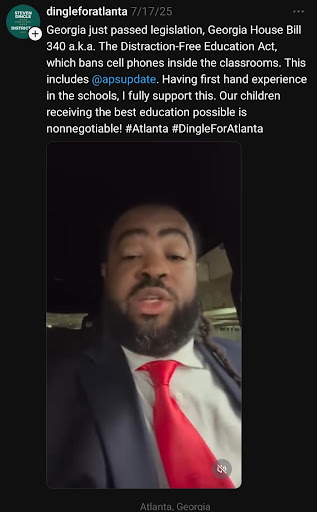
Annotation: Among those who were in support of the Distraction-Free Education Act was Steven Dingle, who ran for a position as an Atlanta councilman last year. Dingle empathized with parents wanting to keep in contact with their children in case of an emergency or other events that occur during the school day. In the video, he urged parents to “trust the system” and have faith in the staff to contact them should something come up. According to an NCES study, over 50% of school officials attributed cell phone usage as having a detrimental effect on student learning and their mental health. While safety is the first priority, students having a quality education follows right after.
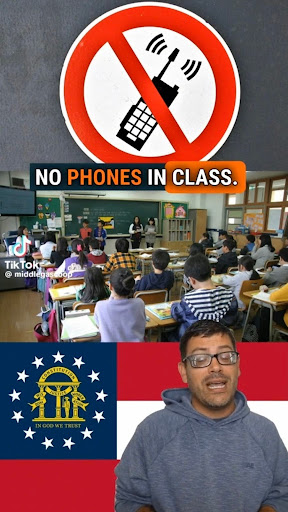
Annotation: In this video, a stakeholder from middle Georgia highlights how counties have reacted following the Distraction-Free Education Act being passed. They were given a deadline of January 2026 to create a deadline followed by a deadline of July 2026 to enforce it in schools. For instance, Rocksdale County’s new policies included the implementation of Yondr pouches to hold student cellular devices from the moment they enter the school premises until they exit. Students will also be held with the responsibility of replacing the pouches should they damage or destroy them. As policies start to be enforced, student attention and engagement is expected to improve.
Annotation: A Georgia teacher took to Reddit ahead of the upcoming HB 340 which was later implemented in January 2026 to see perspectives from other teachers. More precisely, he asked how many days it would take before schools stopped enforcing the policies due to pushback from parents or an abundance of student write-ups from not adhering to the change. One user responded by stating that the system relied on everyone to enforce it. How if just one teacher becomes the one that lets students use their phones, it all falls down from there. In an update post, another user shared their experience of administrators being heavily involved in aiding teachers in enforcement procedures. As the user quotes, “there’s not much for parents to argue with unless they write a letter to the governor.”
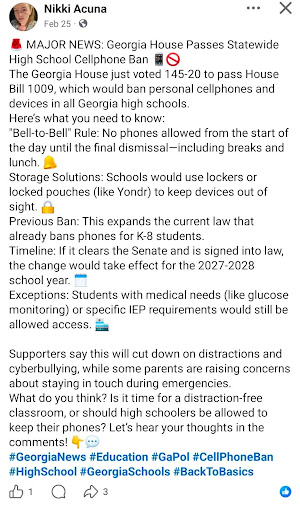
Annotation: A stakeholder on Facebook commented on the recent house vote to pass HB 1009 to emphasize what’s to come. Similar to the ban on K-12, the bell-to-bell system ensures that no personal devices are to be used by students upon arrival until their dismissal from school premises. Furthermore, these devices are to be kept in lockers or the mentioned Yondr Pouches. Only exceptions would be for students who need access to their devices due to medical reasons. After the initial K-12 wave, the high schools are next in line to have the Distraction-Free Act implemented by fall of next year.
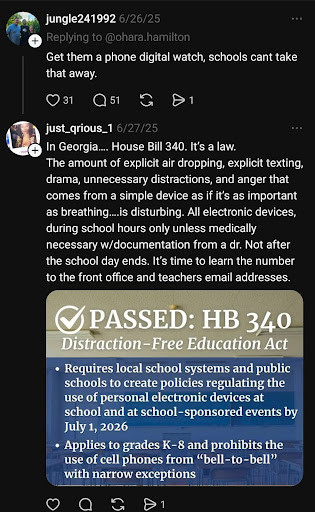
Annotation: In a Threads response to another user on the subject matter, this teacher replied with their view on the bills as sort of a blessing in disguise. She attributes all the hate, distress, and disruptions in the current education setup to students using phones during the school day. Her message to parents and students who are against the new law is how they are up in arms over “a simple device as if it’s as important as breathing.” Instead of arguing with teachers and administrators, they should take the time to learn their contact info if they really want to reach their students.
Annotation: This video is from HB 1009’s founder, Scott Hilton, concerning his bill’s recent approval in the State House. The republican politician, representing GA’s 48th district, elaborates that this bill will encourage higher grades, better test scores, and fewer disciplinary incidents. This is backed by retrospective news reports following Rep. Hilton’s previous endeavors for “distraction free education” with HB 340. According to Capitol Beats, educators have seen a 22% improvement in classroom behavior and, we quote, the law has caused a “transformation in students academically, behaviorally and socially”. Scott Hilton notes the popularity of these forms of restrictions nationally and calls for support in further Georgia education reform.
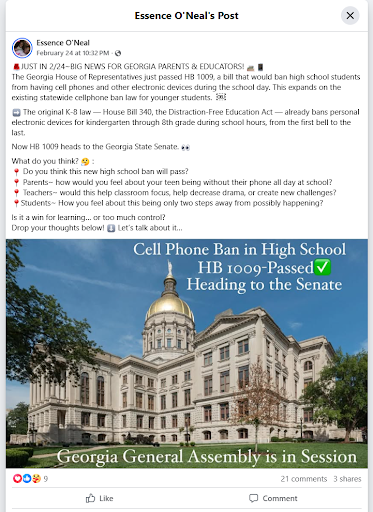
Annotation: In this post, a concerned Georgia citizen, Essence O’ Neal comments on Bill 1900 and reviews the bill origins in HB 340. She also brings up concerns in the event this bill got passed into law. For parents, she asks how they would feel comfortable without their children having some form of communication with them during school hours and for teachers, she wonders if this course of action will really help increase focus in the classrooms. The answer, according to recent polls and data, seems to be yes. In a recent poll conducted by Emory, 71% of Georgia parents supported expanding the state’s ban on cellphones within the classroom. In another study conducted by Georgia Southern, 85% of high school educators supported the various mobile phone policies currently defining HB 1009. Both teachers and parents alike seem to be in support of this bill, despite its drawbacks.
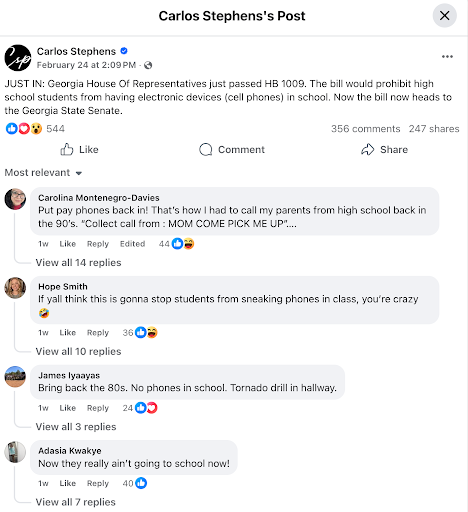
Annotation: In this post, Georgia stakeholder Carlos Stephens shares an update regarding HB 1009 passing the State House and moving now to the Georgia Senate. This post, along with others, are flooded with comments that either fully support ‘going back’ to when cell phones weren’t a part of school’s culture, while other parents are raising concerns that kids either won’t go to school, will sneak phones anyways, or will be stranded in the event of a security threat. While most people agree that cell phones are a major distraction in school, many parents are looking for ways to maximize their children’s participation, engagement, and safety, while mitigating unnecessary usage in the classroom.
Annotation: In this post, reporter Rahul Bali shares the moment HB 1009 was passed in the Georgia House and was sent to the Senate. While Bali didn’t share opinions regarding the decision, the comments on his post ring of government overreach and frustration over an apparent ‘power grab’ by the state. Comments on this post, and X in general, from Facebook, as most people on the other platform seem concerned regarding their children’s safety and education, rather users on X seem to be more concerned about the state Government expanding their reach. At the end of the day, if this legislation passes, it does not become enforced until July of 2027, so true reactions are still yet to come.
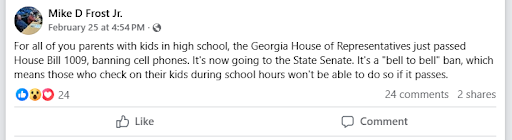
Annotation: This Facebook post from Georgia citizen Mike D Frost, brings awareness to parents on their inability to contact students if HB 1009 should come into effect. Using HB 340 as a comparison, schools must “ facilitate all emergency communication through a school emergency communication management system”, require parents.. who need communication with their students to do so through the school directly and communicate the rules of said system to all academic personnel and sponsors. As of February 25th, HB 1009 has passed the House senate.
Conclusion: Since Scott Hilton’s conception of the “bell to bell” system, there has seemed to little to no pushback on the cell phone bans in Georgia. While some have spoken against the making of this law, the wider consensus among teachers and parents seems to be approval. This is backed by both personal accounts on social media and academic studies conducted in Georgia. Other political figures, such as Steven Dingle, have spoken in defense of the upcoming bill, and seem confident in the state’s ability to both prioritize the safety of GA’s students while still allowing them to have a more fruitful education.
Extensive measures have been put into place to enforce the laws embodying this “bell to bell” act but not without setbacks. While the implementation of different resources such as Yonder pouches and secure lockers has made the process much more manageable, schools still struggle to keep kids off their phones in k-8 following HB 340, even a year after its ratification. This begs the question if high school will fare any better under such circumstances. As of February 25th, HB 1009 has passed the state House and will make its debut on the Senate floor March 6th.
Leave a Reply