CA1 Team 8


Laura S, Jacob G,
Jason D, Max W,
Melissa C
photo by Max W
The debate over sports betting and its legalization portrays a very divided public conversation, a conversation that has spiraled with more controversial discourse as the recent legislative session progresses. HB 910 is at the center of this discussion, which is a bill that would change the existing terms which would allow for online sports betting under Georgia’s law. The debate around the bill reaches past the legislature and goes into social media, religious institutions, and everyday conversation statewide. People who support the legalization of sports betting in Georgia tend to argue on the side of economic reasoning and debate that it would help to keep revenue within Georgia rather than losing it to external platforms. According to social media, the supporters of the legalization are increasing, and have been expressing their frustration on the topic when it comes to neighboring states that have already moved forward with the legalization, and hypocrisy when it comes to the Georgia Lottery in comparison. The detractors of the bill mainly follow the idea of what can be described as a religious ethos. They raise concerns about addiction, the vulnerability of youth, and morals that go against the legalization. groups such as Moms Against Gambling have taken a Stern stance against its expansion. Michael R Griffin, a Baptist lobbyist, has been expressive online as well. He argues that gambling primarily profits off of loss and preys on addiction, carrying no real social value. A lot of the critics of the bill have pushed back against economic promises, arguing that online betting does not include many workers and most likely would not generate employment. Debates about high school athletes being profited off of through NIL have also been a prominent topic, adding tension that many stakeholders have acknowledged. Religious, economic, and public health concerns all pull the conversation into separate directions, making the overall consensus about Georgia sports betting legalization up in the air.
The Christian index which is the official publication of the Georgia Baptist convention got on Twitter before the 2026 legislative session and said that Georgia Baptists were getting ready to fight against gambling legislation at the Capitol. The post tags Michael R Griffin and the Georgia Public Affairs Ministry. This shows the coordination involved within the opposition of the bill. Peachy Voter, a Georgia-centered political stakeholder account, shared a response supporting that opposition. Within the response, they expressed hope in which sports betting and gambling bills will be put to an end and highlighted how religious organizations are working against the legalization with the Baptist Network for help.
Moms Against Gambling enthusiastically announced that Republican Steven McNeel was recently elected senator. This strengthens the Georgia assembly against gambling laws, given that this senator is known for anti-gambling beliefs. After an election with no clear winner, McNeel won by a landslide in the runoff election this year, with key issues being cutting taxes, protecting the second amendment, supporting pro-life values. Moms Against Gambling is a Georgia based organization focused on raising awareness and providing resources to parents and grandparents. The organization encourages stakeholders to call elected representatives and voice their concerns on gambling legislation. With 970 followers, this account has a small but loyal following united behind their cause.
Capital Lobbyist Michael R. Griffin makes a strong commentary on the detriments of casinos. As the author of the article cited, Griffin claims that misery is the outcome of gambling practices, insinuating that further legislation to break barriers in gambling should come to a halt. Additionally, Griffin is Baptist Pastor, further showing the relationship between religious organizations and anti-gambling initiatives. Griffin is also a lobbyist at the Georgia capital, using his position of authority to voice the concerns of Georgia Baptists. This scathing commentary on anti-gambling practices is sure to make its way to the capital, given the Griffin has been an active member in politics for multiple causes.
Active sports fan and twitter user Georgia Power voiced concerns on HB 910, the current bill in progress in Georgia’s General Assembly. In this post, he shed light on the potential corruption of the Georgia Lottery being the regulator of sports betting whilst also holding power in other gambling jurisdictions. From other recent posts, this stakeholder appears to have an overall positive outlook on online sports betting, with a distaste in Georgia Lottery taking the reins on it. Georgia Lottery already has an app that exploits its users through casino services on a mobile app, raising concern for monopolization if HB 910 is passed.
Joseph D’Angelo’s tweet is an affirmation of the dissenters. Using a statistics based appeal, He is framing the conversation as exploitation. Interestingly, D’Angelo’s framework is not an analysis from a labor/capital standpoint but from a health perspective with some religious ethos sprinkled on top. The “86% of profits from the 5% most addicted” brings some important concerns. Firstly, cash flow ala profits may not return to the state well even if the revenue can be significant. Secondly, the combo of online betting with high school athletics being sponsored could expose people to more addictive environments.
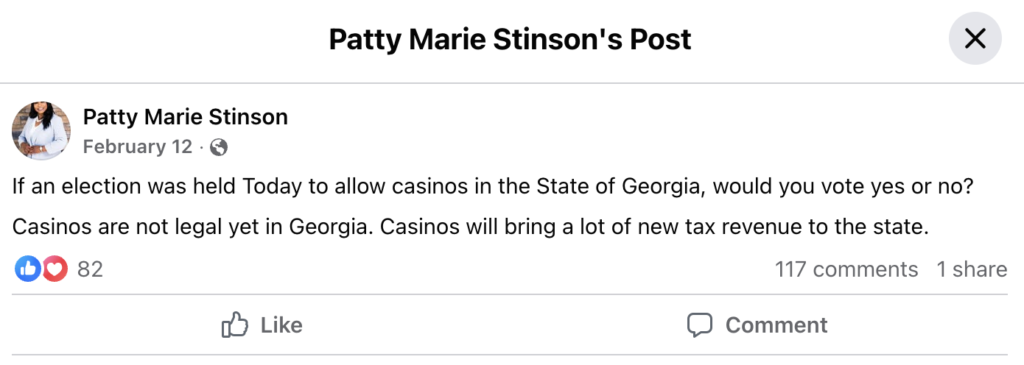
Patty Stinson’s Facebook post is a highlight of general public approval on a small scale. Stinson raised a hypothetical of legalized casinos in Georgia. From this post, the majority of the responses were in favor of legalizing casinos. With the bills in this state session, these people are ones likely to vote in favor of HB 910. People in the comments either plainly agree or consider some material concerns like travel costs. The few against legalizing consider it like a regressive poverty tax. This artifact’s demonstrating that a large portion of the citizens are thinking immediately on upfront tangible costs but not social costs.
Rep. Ed Setzler’s post clearly marks his position against HB 910 through an addiction focused lens. While not citing the bill directly, Setzler makes his case by using Ohio for his justification. Jeremy Pelzer’s coverage highlighted the Ohio governor’s oversight from legalizing sports betting. Betting became very pervasive and the governor was concerned for sport integrity. Setzler using this article shows him considering how the state may not be able to handle a proliferation of ads and addiction. He may be alluding having more state control of gambling so it does not cause more harm than intended.
Mark Zinno, a verified Twitter user, uses sharp wit in his tweet to call out what he sees as a contradiction in Georgia’s legislative priorities. Responding to news that the Georgia House unanimously passed a bill allowing high school athletes to profit from their name, image, and likeness, Zinno questions why the state is comfortable monetizing young athletes but resistant to legalizing sports betting. With 6,040 views, this post gained significant traction and reflects a growing frustration among HB 910 supporters who argue Georgia’s selective approach to commercializing sports reveals an inconsistency that undermines the moral arguments opponents use against legalization.
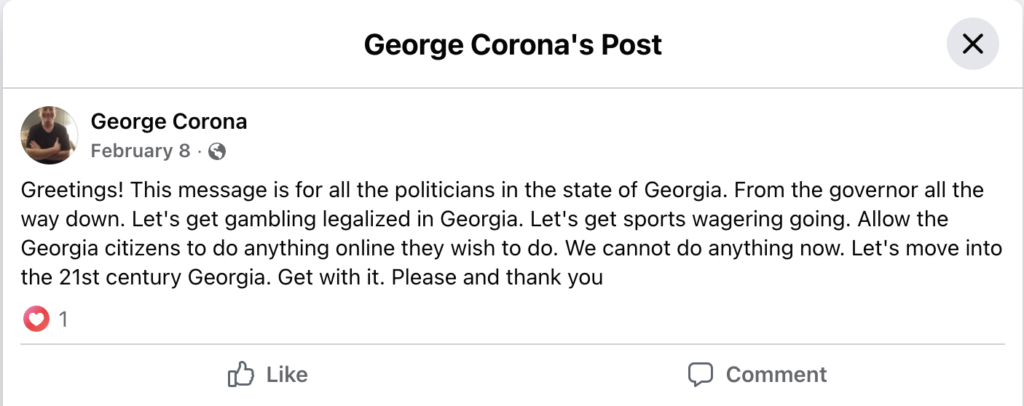
Georgia resident George Corona addressed his Facebook post directly to state politicians, from the governor on down, urging them to legalize gambling and sports wagering in Georgia. Framing legalization as a matter of modernization, he argues that restricting online gambling leaves Georgia behind other states. While the post received minimal engagement with only one reaction, it represents a segment of everyday Georgia citizens who view HB 910 as a simple matter of personal freedom and keeping up with the times. Posts like this demonstrate that public pressure for legalization extends beyond organized advocacy groups into direct, unfiltered appeals from constituents to their elected officials.
Huey K. Bridgeforth‘s post provides straightforward civic commentary on HB 910, noting that if passed, the bill would allow fans to legally bet on major Georgia sporting events like the Peach Bowl while keeping tax revenue within the state. The pairing of this message with an image of a bustling sportsbook floor adds visual appeal and frames legalization as an exciting and normalized activity. The post functions as informal public advocacy, spreading awareness of HB 910’s economic argument to followers who may not follow legislative news closely. Notably this post gained around double the amount of views since the last time viewed.
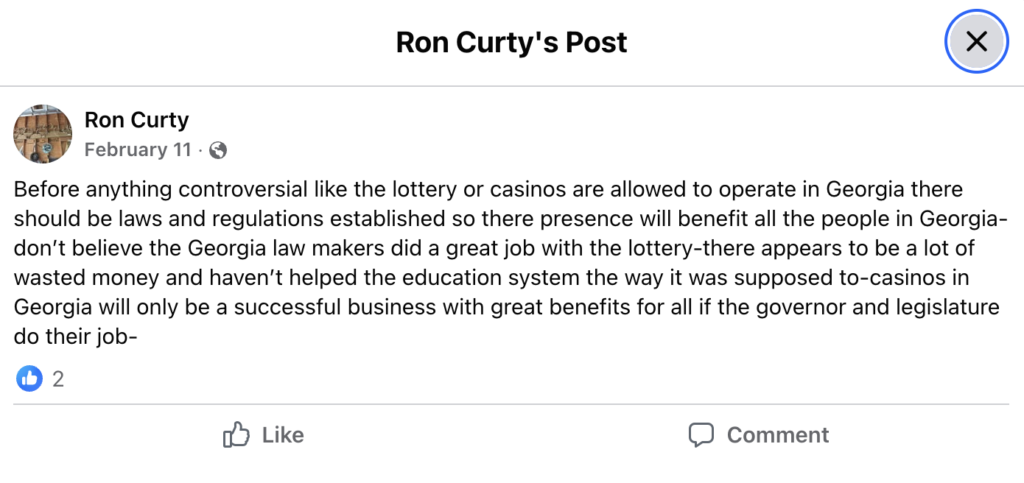
Ron Curty, Georgia stakeholder, in his post cautions against the legalization of gambling without the proper regulations in place to ensure that the stated benefits to all would be achieved. He draws attention to how in Georgia’s existing lottery system a lack of transparency and regulation meant the program is missing its goals to improve our education system. There is a long history of these deregulation bills resulting in increasing wealth inequality and siphoning money and resources away from impoverished communities that have little enough to begin with. These hastily made rules and systems often result in large dependent businesses that are hard to undo without massive job losses.
In a post by RlinnehanSR he points out that Georgia lawmakers and regulators appear to have little interest in pursuing meaningful regulations that would safeguard against the negative effects of gambling or direct it’s proceeds in a manner beneficial to Georgians. He is also points out that there is “not much of an appetite for legalization”. This suggests that progress for Georgia gambling legalization is a product of a force outside Georgia and not something desired by Georgia residents or their representatives. There is a long history of the gambling industry seeking to break into and profit off of new lucrative markets with little concern as to the effects on the community.
This post from Public Affairs Ministry is seeking to stole outrage and distrust of sports betting legalization by drawing attention to two KSU students involved in an international sports betting scheme. Any where in any situation where laws exist, people will break them and while this demonstrates that gambling can be exploited it does not seem to show that it is more or less exploitable than any other enterprise. Which seems to be the intention of this post. While this is part of the public discourse on gambling it does not appear to be interested in productive discussions on gambling in Georgia, but an attempt to demonize gambling in general which seems to be consistent with their organization.
Overall, sports betting legislation in Georgia is a widely debated topic that has gained public popularity over the past few years. HB 910 is at the forefront of this discussion, being first introduced in 2025 and revisited now in 2026. It appears to be at a standstill at the moment, with the latest stage being at the house second readers at the beginning of this current session. After a thorough review of the current journalists, politicians, and stakeholders involved in this bill, it was found that a negative response outweighs the positive hopes for the passing of this bill. Notably, there are many religious figures and groups raising concern for sports betting regulation, including Baptist pastor Michael R. Griffin and Christian focused political twitter account Peachy Voter. On the positive end, stakeholders such as Georgia Power and George Corona hold a positive outlook on legalizing sports betting, with Corona stating that it is simply a means of modernization. With more negative buzz than positive, this may be the reason why this bill is stalled in the second reader stage. Based on the engagement with the current legislation, it is looking like sports betting will be delayed for more years to come.
Leave a Reply