Kansas and Georgia are the Newest Additions to the Growing Number of States Banning Cellphones in the Classroom

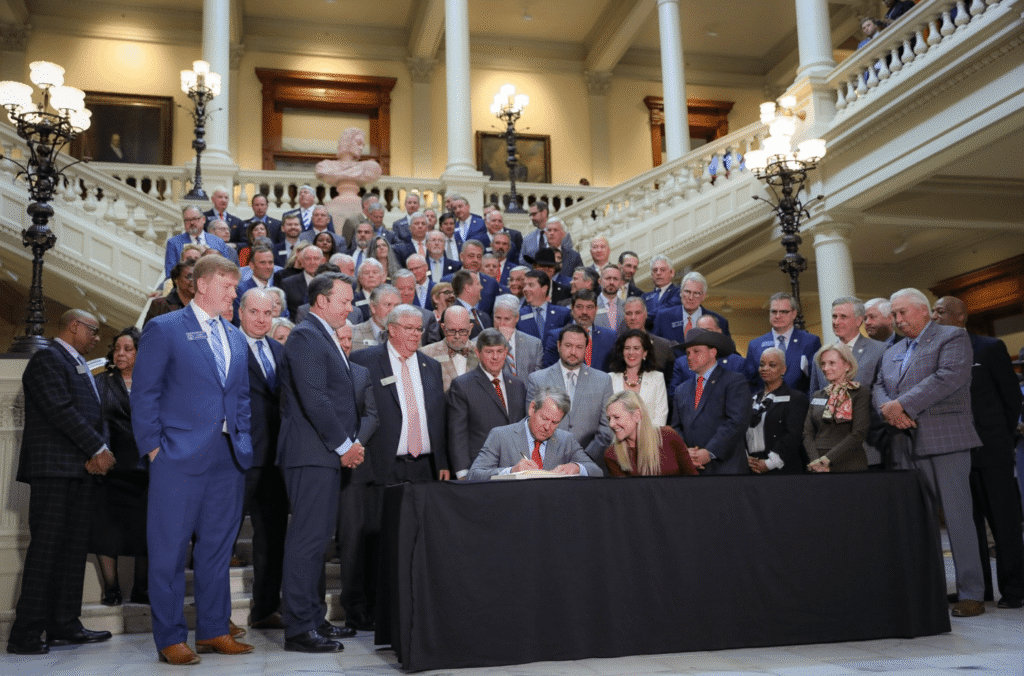
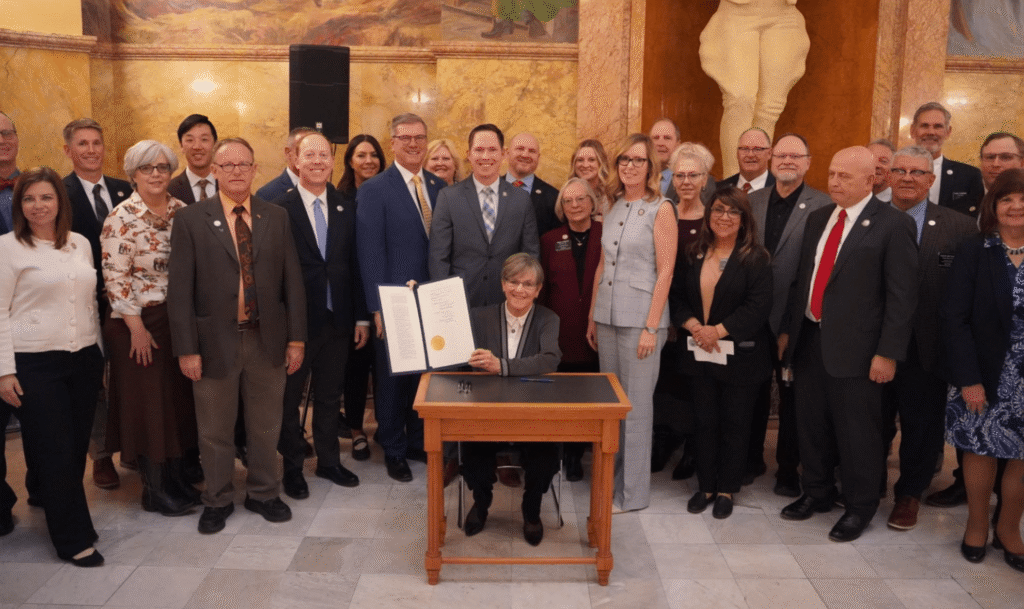
As of March 23rd, Georgia passed into law HB 1009. Also known as the “Bell to Bell” act, it works to ban all cell phone use among Georgia 9th to 12th grade students during the operating hour of school. For more information regarding Georgia’s HB 1009 and its foundation in HB 340, please refer to our previous article. States have taken various degrees of restriction to mitigate distractions during school hours. The motivation behind said restrictions has also varied by a wide margin and can be tracked to a plethora of different reasonings. Kansas has taken an interesting stance on the subject with its recent legislature, HB 2299, citing an effort to combat discrimination among students as the primary reason behind its ratification. Both Georgia and Kansas have met a variety of criticism regarding the legitimacy of these two pieces of law, mostly from disgruntled parents worried for their children’s safety.
In this tweet, Kansas speaker of the house, Dan Hawkins gives a statement on HB 2299 and shares assurance that, “this law is about putting students back in a position to succeed.” New studies seem to confirm this statement and further enforce the legitimacy of cell phone bans. In one literature review conducted by the nonprofit, nonaffiliate Paragon Health Institute, legislation banning cell phone usage during school hours has shown a nationwide decrease in bullying and behavioral issues among students. There’s also been different degrees of success concerning the various restrictions being put in place. “Bell to bell” bans, while more effective in helping students focus, require more, possibly unsustainable, infrastructure investment. Instructional bans, a less restrictive cell phone regulation that do not remove the phone from the classroom but monitors their use, has been easier to implement, but harder to enforce.
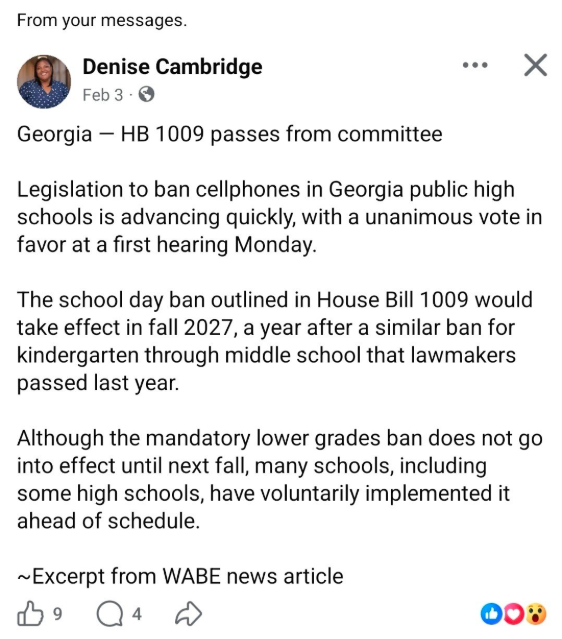
While HB 2299 was being considered in Kansas, HB 1009 was being approved in Georgia to take effect in fall of 2027. A Georgia stakeholder took to Facebook to share the news where other users displayed their reactions. One user showed concern for students who have apps in their devices to deal with conditions such as Type I Diabetes. As they rely on the apps, it could put them at risk should they be separated from them. Another user replied by stating that they should embrace technology rather than suppress it.
“It was only through text messages that parents knew what was happening,” said Tinya Brown, whose daughter is a freshman at Apalachee High School, northeast of Atlanta, where a shooting killed two students and two teachers in September. She spoke against Georgia’s law at a news conference in March.“
In reference to last year’s bill that banned phones in grades K-8, Representative Scott Hilton stated “this is a mental health bill. It’s a public safety bill.” A Georgia parent touched upon the bill by sharing the story of her daughter who was present during the 2024 Apalachee High School shooting. Her stance is that her daughter’s communication via texts is the only reason she had any idea of what was happening as those events were occurring. On Reddit, a Kansas parent shared a similar viewpoint in which their students did not have access to their phone and became separated during a school wide emergency.
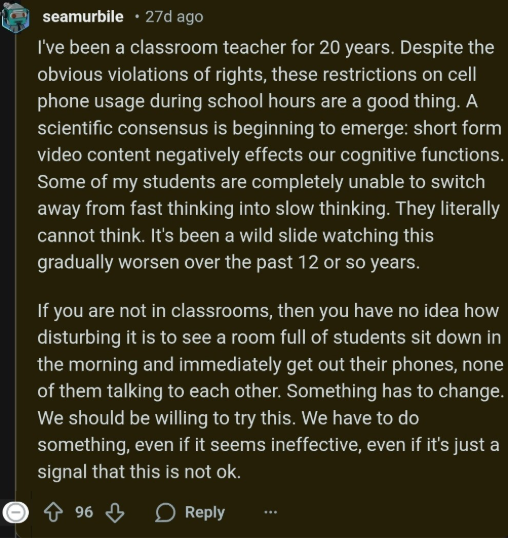
On a Reddit post about Kansas Gov. Laura Kelly signing HB 2299 into effect, a teacher and a former student commented on the topic with similar thoughts. However, they viewed the bill on a different scale. The teacher viewed the violation of rights as a necessary sacrifice to reduce the detrimental effects to student attention span and social interactions. As for the student, he didn’t see the issue as serious as it was being made out to be, but was still in support of students not having phones during school.
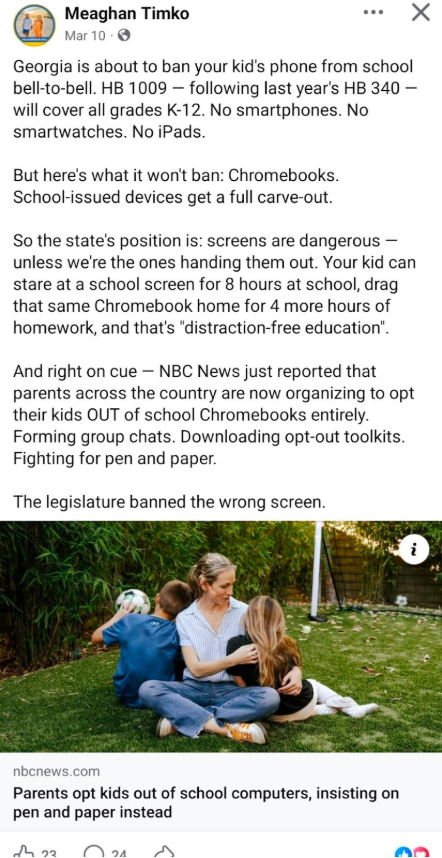
A Georgia stakeholder on Facebook spoke out against HB 1009 aiming to claim the remaining portion of grade levels not covered by HB 340. Her viewpoint is that all devices should comply under the same regulations and those handed out by schools shouldn’t get an exemption. Simultaneously, a “distraction-free” education isn’t one where chrome books are to fill the gap left behind by personal devices. A teacher points out in the article by Magnusson et. al, “They sit and watch movies and do other things. I have seen the computer as an obstacle as well, many times, in fact…” Even school-issued computers could potentially become a distraction once students learn to bypass restrictions.
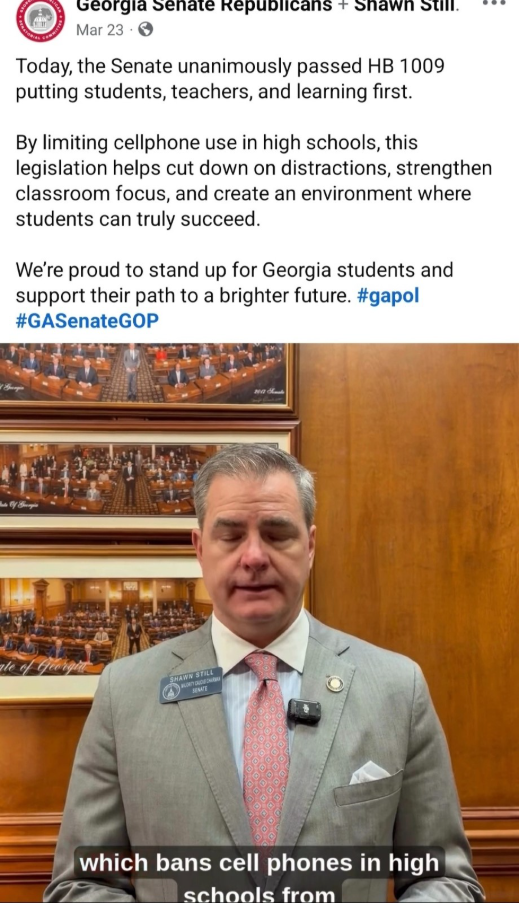
On Facebook, Georgia Senator Shawn Still collaborated on a post with the Georgia Senate Republicans account to announce the passing of HB 1009. Still references the fact that Georgia will become the 27th state to pass a similar bill. He also believes the bill will make schools safer and ensure teachers won’t have to be “cell phone police” on top of their other obligations dedicated to students’ education. A Georgia stakeholder replied by calling upon the school administrators to take the initiative to actually enforce these regulations if they truly are committed to the idea of cell phones being a distraction to student engagement. v
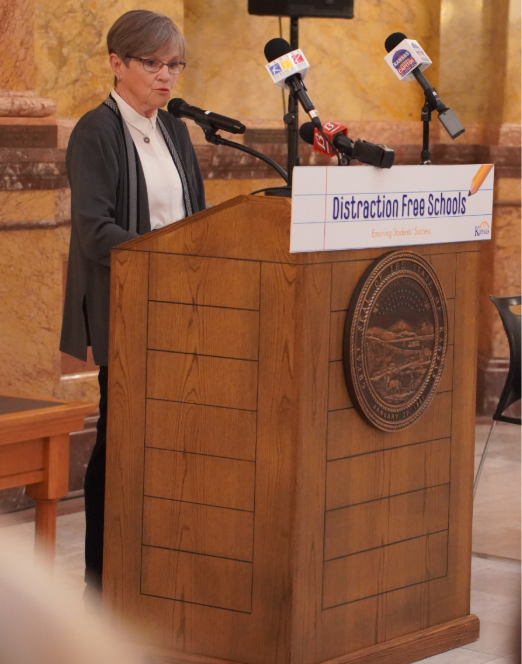
In one News article released by the Kansas Governor’s Office, Governor Kelly spoke on the large amount of bipartisan support that influenced this bill’s passing. With a senate vote of 34-4 and 84-39 in the house, it’s fair to say many party boundaries were broken in bringing this legislation into law. Senate Republican majority leader Chase Balsi, who stands in stark contrast to Governor Kelly, commented on the legislation saying how proud he was that everyone came together to, “pass a bill that puts kids first.” Georgia saw similar success in the passing of HB 1009 with a House vote of 145-20 and a unanimous senate vote of 52-0.
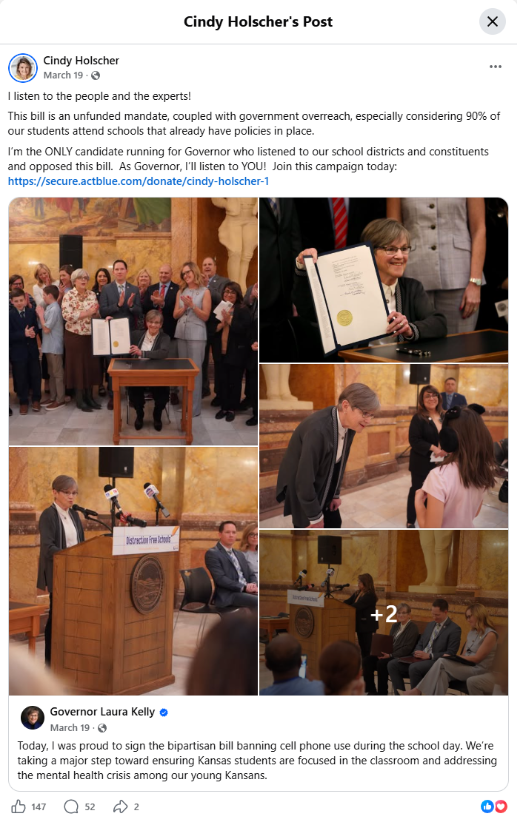
Though the bill has passed both the Kansas House and Senate, some representatives remain unpleased by the outcome. Cindy Holscher, the Democratic Representative of Kansas’s 16th district, vocally opposed the passing of HB 2299. She points out that many schools already have policies in place that combat cell phone usage during school hours and that such use of State power to nullify said policies is overreaching. Governor Kelly responded to this argument by stating, “When our students’ mental health and academic performance are on the line, I felt strongly that a statewide solution was best.”
The questions of safety and overall validity concerning these new bills don’t end with legislation. In one interview conducted by FOX5 Atlanta, a student at Apalachee High School, Sasha Contreras, recounts her terrifying experience in a 2024 school shooting. She refers to her phone as something of a “lifeline” in which she was able to contact her mother and sister after the incident and confirm her safety. Sasha’s sister, Laila Contreras, is the founder of the community advocacy group Change for Chee. She says, “The first phone calls to 911 were through student phones” on the day of the shooting. With the new act scheduled to take effect December 31, 2026, concerned students and parents alike await to see what kind of emergency systems will be put in place to protect children’s safety.
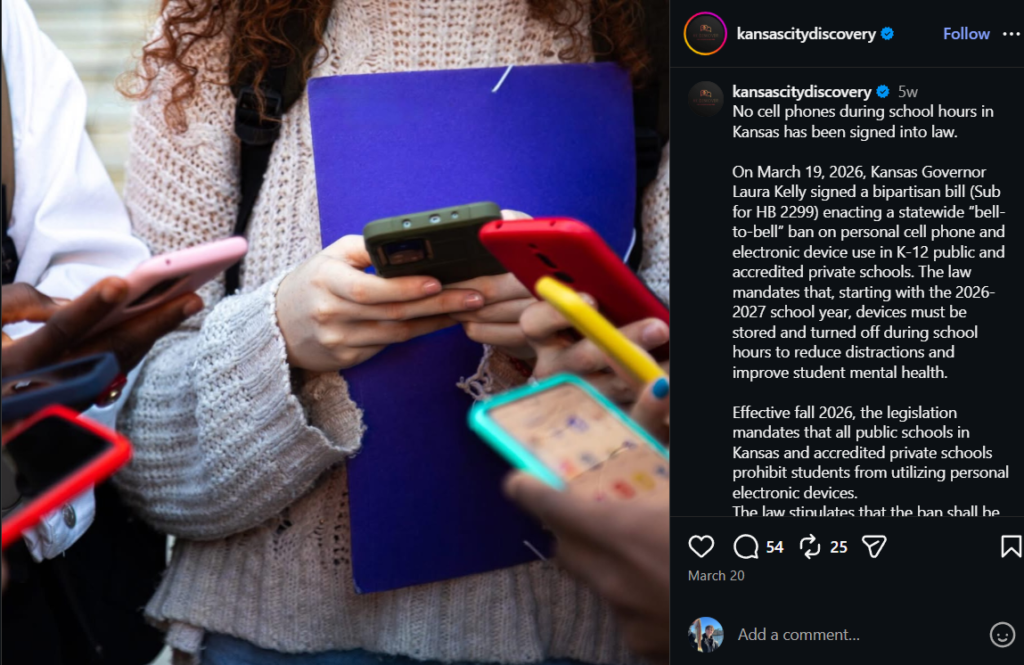
While some praise the bill, many people still question how it will impact the safety of students in school in the case of a shooter or active threat. In an Instagram post by Kansas City Discovery outlining the bill, most comments left on the post exhibit concerns over banning phones rather than focusing on preventing school shooters. While some high schoolers and parents are upset, experts have noted there has been a direct correlation between students who “engage in off task use and frequently use their mobile phones for non-educational purposes” and failing course grades. Overall, parents in Georgia and Kansas have been vocal about the states priorities and feel that, while phones are a distraction in school, they are also the only means for parents to contact their children if a school shooting does occur.
Though there are many difference in Georgia and Kansas’s approach to banning cellphone in high schools, their primary purpose seems to be the same: make a better learning environment for students. Studies have shown that while there is a need for restriction, with 95% of students having access to cellular devices and over half of them reporting excessive social media usage, these new bans aren’t necessarily the perfect answer. In another study concerning how students reacted to other states phone bans, researchers found that the phone collection procedure was cumbersome and created “negative tensions” between students and teachers. It was also noted that cell phones have become an important part of the learning process in high schools, and that removing easy access to the internet might detract from the overall learning experience.
The validity of these bills has been called into question by a variety of students, parents and politicians. In Kansas, Representative Holscher, speaks against government outreach, and urges her fellow member of the Senate to give schools autonomy in the management of student phones. Concerned parents such as Vanessa Miles Neal ask about children with special needs and how their needs will be met. In Georgia, advocacy groups and school shooting survivors have spoken against this bill, citing it would remove a “lifeline” for students in the case of an emergency. As both states move forward with this restrictive “Bell to Bell” act, these concerns will become more prevalent in the spring semester of 2027 once these bills take effect.
Leave a Reply