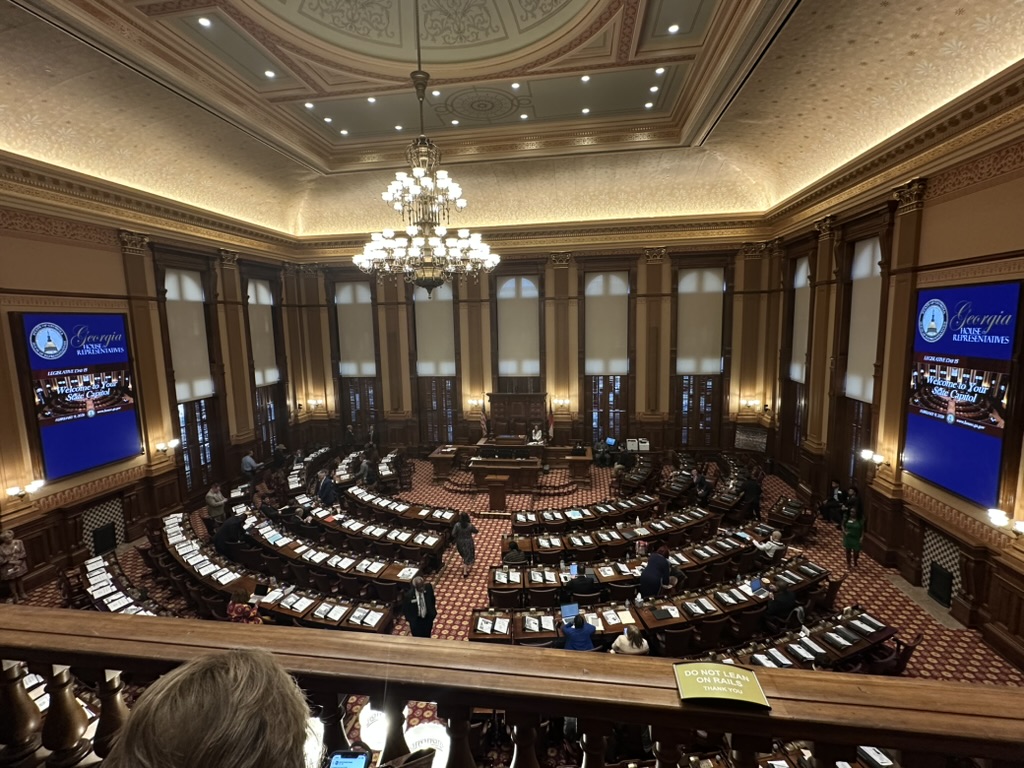
CA1 Team 1

Photo by Katherine N.
CA1 Team #1:
Jacie T, Katherine N,
Calvin W, Alexander E
With recent occurrences and controversies across the country, Georgia has had some of its own incidents and introduced a few bills to rectify some of the problems the incidents have caused involving ICE. Between Social Circle, non-profit organizations, and prospective politicians, discussions have arisen, bills have been introduced, and further controversy has become more mainstream. This topic began as a consideration due to the happenings in Social Circle, where a warehouse was bought out by Homeland Security to become an ICE facility. Several laws have been introduced to reduce the anonymity of ICE agents, and a few conversations have happened amongst Non-profit local organizations and protesters to further inform the public and help in raising awareness. Discussing this topic, ICE has become a specific point of conversation, especially to the average Georgian, and here we will bring up some of those instances of discussion, as well as bills addressed towards the issue, and assist in informing more people about what is going on and what their peers have to say about it. The linked artifacts will all reflect a different topic within this overarching topic, each bringing attention to different issues or solutions, each from either a stakeholder or someone involved in or with the media. Here we will analyze and synthesize the data and information collected from each of these artifacts to help build the picture, as well as provide an outlook for where the topic is going, who to look out for, and what to expect. Overall, the artifacts put together should give a good idea of what is going on, what is being done about it, what an individual can do about it, and how to inform themselves.
_____________________________________________________________________________________________________
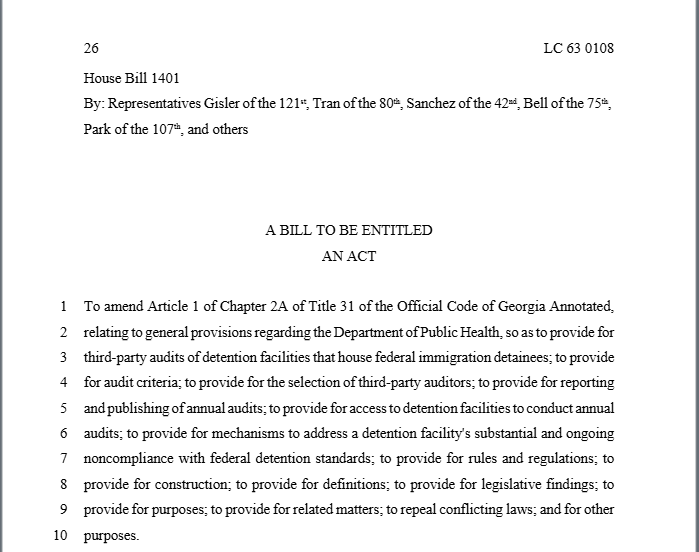
Due to the rise of ICE work and detaining immigrants within detention centers, there has been less compliance with living standards and conditions. To ensure the national standards of ICE by mandating reviews of living conditions, HB 1401 was introduced to establish a third-party auditing process. What this means, if it is passed, is that detention centers will be reviewed or audited based on health, safety, and human rights — according to the bill. If this bill is passed, detention centers must remain transparent and hold more accountability, which is something that is currently lacking. Passing a bill that could improve the quality of life for people being detained within detention centers is imminent. We can see rising numbers of people being shoved into these centers and the purchasing of property to build more. In an article written by Lautaro Grinspan, Georgia reportedly purchased one of the largest detention centers, where as many as 10,000 immigrants could be held. To ensure these audits are carried out, it would be beneficial to require the reports to be unannounced, which can increase accountability or transparency.
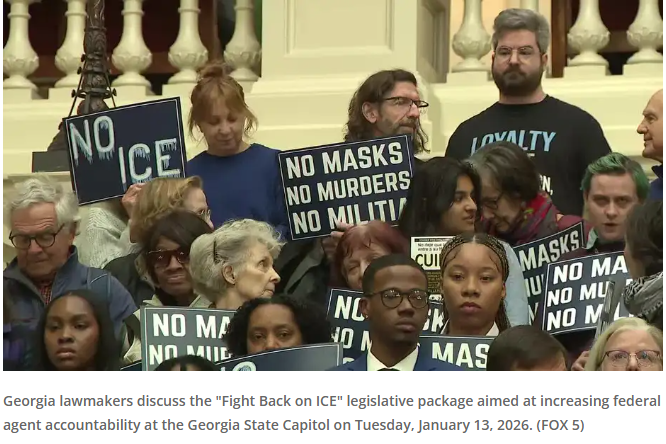
The Fox 5 article “Georgia Democrats file ‘Fight Back on ICE’ legislation to ‘unmask’ federal agents“ by Deidra Dukes and Travis Maurer covers the general initiative from Georgia state democrats to “push back” on ICE (Immigration and Customs Enforcement) in Georgia. The bill was published at the beginning of the session on January 13th, so the legislation discussed in the article was a reaction to ICE activity in other states, such as Minnesota. Issues, such as the development of a detention center in Social Circle, were not part of the conversation driving legislation yet. However, the prevailing narrative that state democrats want the bills and state republicans think that they’re unnecessary had already begun to emerge, as can be seen in this article. The bills discussed in the article (SB 389, SB 390, SB391, SB397) had not been made public at the time the article was published. Now, each bill mentioned has been read and gone to committee. There has not been an update on the listed Senate bills since the move to committee on January 14th, 2026. However, as we will see with the other artifacts in the post, they still have a significant amount of publicity and public awareness.
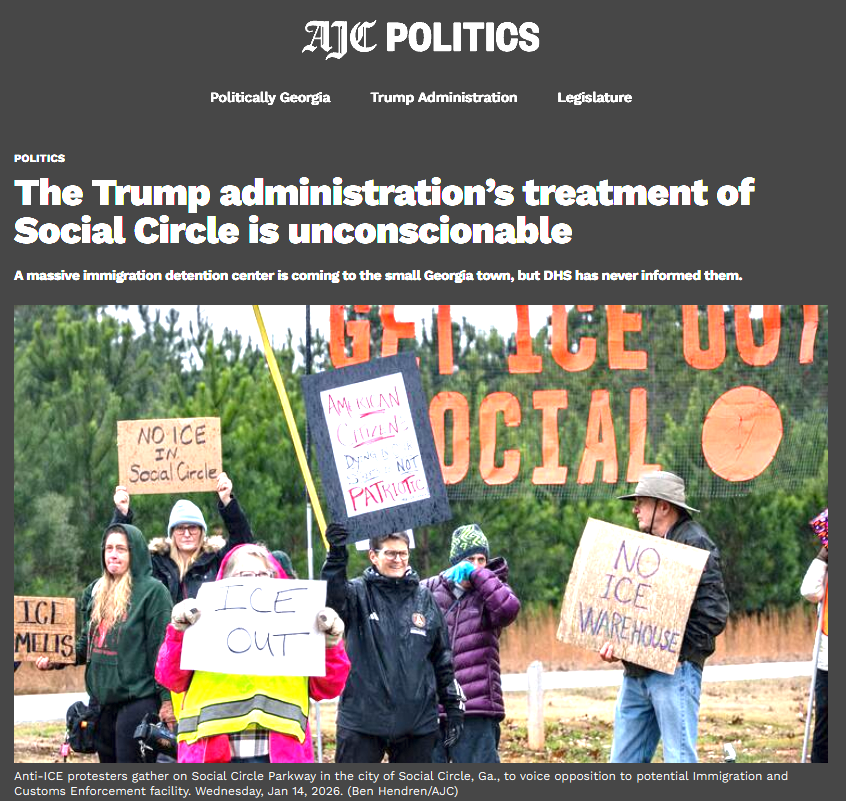
The article “The Trump administration’s treatment of Social Circle is unconscionable” is an AJC opinion piece written by Patricia Murphy. Within the piece, Murphy discusses the city and state-level backlash to the federal-level decision to utilize a warehouse in the city of Social Circle as an ICE detention center. While the construction of the detention center is a federal-level decision, that doesn’t mean there aren’t state-level consequences and related politics in the Georgia General Assembly. For example, more attention is being given to existing bills as more individuals find information about Social Circle. This can influence the public’s perception of the bills and incentivize a legislator’s decision on a bill. One such article that could apply to Social Circle is SB390, which prevents “outside armed forces” from entering GA. SB390 is intended to prohibit outside armed forces from coming into Georgia without the permission of the Governor. While not built for this situation, SB390 could be potentially used to prevent ICE-related activities in Georgia without approval from the governor. Even more relevant is the bill HB1401. The bill would require transparency from detention centers and require them to report to the public department of health with more clear and strict standards than previously existed. Additionally, silence can be as significant as being vocal about an issue. Social circle’s legislators are Representative Tim Fleming (R-114 district) and Senator Brian Strickland (R-42 district). However, they do not seem to be posting or mentioning the potential detention center or similar ICE-related topics.
Follow orgs focused on immigrants rights like (@glahr.ga @asianaaf @advancingjustice_aajc @advancing_justice_atl @gamvp @casa4all @instabaji) Then pick up the phone or show up to the Georgia State Capitol to demand more from your state representatives and state senators. Between now and April 2, decisions are being made under the Gold Dome that will impact all of us. It’s time to get loud, get active, get organized. We got us.
This is the caption to a video, posted by wfpgeorgia on Instagram. The post highlights many activities Georgia residents can and have done to protest ICE in the state of Georgia. From what college and high school students have been doing to what residents can do if they want to help push back against this issue. Such as attending legal training on documenting ICE, staying up to date on Georgia’s legislation, and following state politicians. The post also provides links to immigrant-rights organizations’ profiles, like glahr.ga. A growing number of people get their political news from social media instead of finding out what bills are being introduced. This video mentions these specific bills: SB389, SB390, SB391, and SB397. It is also mentioned in the caption that there will be a protest at the Georgia State Capitol on April 2nd. This post is a standout example of providing impactful and helpful information to create change through social media. Not only does it provide bills that limit ICE, but it also provides a bill that infringes on detainees’ rights. SB116, which requires a DNA sample from anyone detained, but makes no mention of those samples being deleted for wrongfully convicted individuals. All of the bills talked about in the video will have a massive role in how the Department of Homeland Security will operate within the state of Georgia. It is why this post is so important because it not only talks about what these bills will do, but also how the people in Georgia can help stand up for the changes they believe in.
A majority of the bills that have been introduced in the current Georgia General Assembly session are Democrat sponsored. However, these bills seek to limit the actions of ICE that we see in the state of Georgia. A tweet on X from Indivisible Cherokee United mentions SB 390, 391, 397, and 389, which are bills that limit ICE in Georgia. As the tweet shows, many people know mostly about the top 4 Senate bills due to early introductions. However, despite these bills being first introduced at the beginning of the session, they are important to pass for establishing more regulations. SB 391, which makes certain places unable to be entered without a judicial warrant. SB 391 is sponsored by Senator Nabliah Parkes (D-District 7) and only has Democrats backing it. As previously mentioned, this bill, along with the others, was introduced early in the session. It will be extremely important to keep a close eye on this bill as we head into crossover on March 6. Should these bills be passed, we could see increases in security measures, human rights, and overall, they will eliminate safety concerns for immigrants.
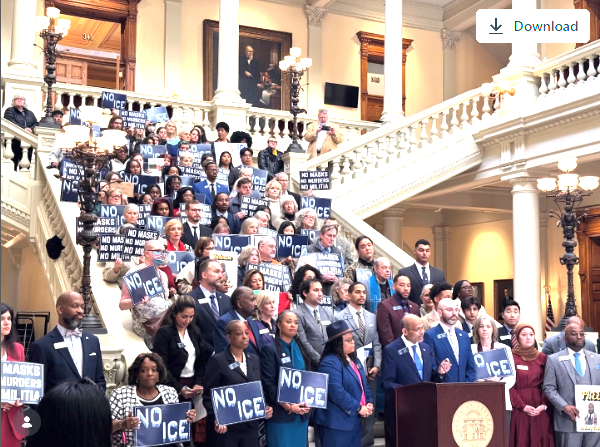
Today, hundreds of community members and several legislators gathered at the Georgia State Capitol to send a clear message to ICE. No masks. No murders. No militia. No ICE.
In this Instagram post from Georgia House candidate Nico Parra, Parra calls out specific bills and legislators he supports. Overall, the post signals to the public that he supports ICE regulations, which gives the impression that it is an important topic to his potential constituents. Through his post, Parra is implying that, if he is elected, then he will vote for similar bills to be passed. As the post was made at the beginning of the session, the bills mentioned are SB 389, SB 390, SB391, SB397. However, Parra is a candidate for the House, which has its own ICE-related bills that were developed after he posted. These are bills HB1044, HB1050, HB1053, HB1401, HB1265. In the post, Parra thanks Senator Sheikh Rahman (D-5th district) for the invitation to witness a press conference held by legislators. This is significant because it reveals that the awareness the public has for the senate bills relating to ICE was an intentional push from legislators at this press conference at the beginning of the session. Additionally, Sheikh Rahman is one of the co-sponsors for SB 389, so he was specifically trying to get more people to be aware of the bill.
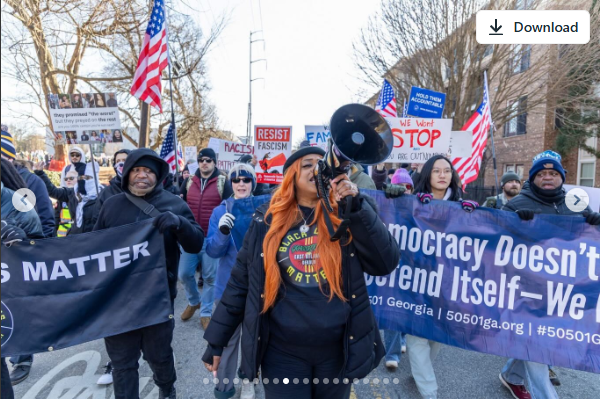
One of the ways voices can be heard is through protests. There has been a rise in protesting ICE, with a movement called ‘ICE Out’. We have seen celebrities wearing pins on red carpets, but also organized motions within Atlanta. Queen Miller, an established activist in Georgia, attended a protest titled “ICE OUT EVERYWHERE,” which was organized by the grassroots group ‘50501 GA’. She wanted to advocate for SB 389, 391, 397, and 390, which are bills that have been prevalent in the current session. Having people protest allows voicing demands, obtaining justice, and gaining accountability of unjustified violence for individuals, as quoted on Miller’s Instagram post, “#justiceforkeithporterjr #justiceforhebersánchez #justiceforreneenicolegood #justiceforalexpretti”. By directly addressing and stating the names of people who were unrightfully killed by ICE agents during protests, it calls for higher investigations and transparency. With more outreach of protests, there will be more strength in numbers, which in turn can create better accountability.
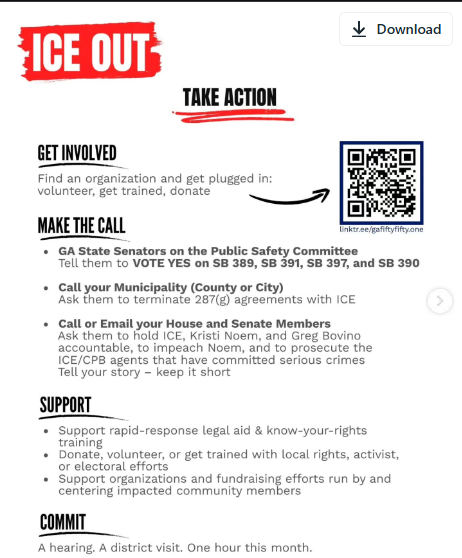
This Instagram post from the Georgia branch of the organization 50501 mentions SB 389, SB 390, SB391, SB397, and implies that the bills are being reviewed by the public safety committee. 50501 is a non-profit organization focused on rallying its local communities in response to public issues. The post here was specifically made after an anti-ICE protest in Atlanta, Georgia, which was organized by 50501, and shows they are attempting to push for specific bills in response to ICE activity in Georgia. The post is pushing people to call their senators to attempt to push the bills to advance and to be voted on in the Senate, so the bill could move on to the House. They’re doing this by raising awareness for the bill’s existence and capitalizing on general public unease about ICE activity in other states and the potential increase in ICE activity in Georgia, such as that in Social Circle.
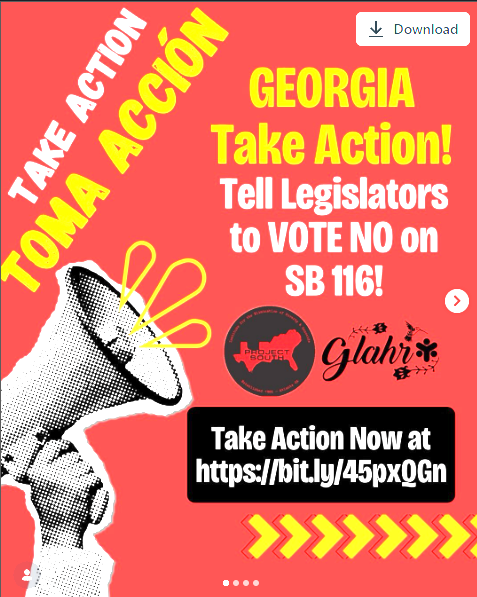
This is a post by the Georgia Latino Alliance for Human Rights, which calls on the people of Georgia to contact their legislators and urge them to vote no on SB116. This bill requires anyone who has an immigration detainer notice and has been charged with a misdemeanor or felony to have a DNA sample taken. The change is that it is no longer just a requirement for felons, it is also a requirement for people charged with misdemeanors. An immigration detainer notice is a request from ICE asking a jail to hold someone for up to 48 extra hours after they would normally be released, so ICE can take custody. This means that someone charged with a misdemeanor traffic violation could face an immigration detainer request and have their DNA collected. The main concern for this bill is that if someone is wrongfully convicted, the DNA sample won’t be deleted. This policy targets immigrants for additional DNA collection based on a detainer that may sometimes be issued by mistake. This bill, along with other bills like SB549, which prevents the state government from providing funding, resources, or other support to detention centers in Georgia, will play an important role in the Department of Homeland Security’s plan to build centers in Georgia.
The City of Social Circle just participated in a call with Congressman Mike Collins and members of his staff regarding the PNK property.
During this call, Congressman Collins and his staff advised the City that the PNK property is currently in escrow and moving toward final purchase by the U.S. Department of Homeland Security for the purpose of establishing an ICE detention facility. According to Congressman Collins and his staff, the site was initially considered as an alternative location; however, certain operational metrics ultimately aligned, resulting in the property being identified as a preferred site.
City officials were also informed that the Department of Homeland Security has conducted an engineering evaluation of city utilities, and that economic impact reports are currently being prepared. These reports are not yet finalized. The City of Social Circle has not been asked for, nor has it provided, any input related to this evaluation or planning process.
City officials have formally requested that this information be provided to the City in writing, including clarification on the anticipated timeline. Congressman Collins and his staff indicated that housing at the facility is expected to begin as early as April.
The City of Social Circle will continue to seek verified information and will share updates with the public as they become available.
This post, made by the City of Social Circle, outlines a significant point of reference in that the city itself has been mostly left out of the process going on with the warehouse that has been bought out by the Department of Homeland Security. This is a major issue, as there is absolutely no transparency going on regarding what is happening between this warehouse and those in the city or those in charge. There was a formal request for more information, which, as the post outlines, was not given, as well as a failure to reach out to the city itself to aid in any possible construction or other information gathering, thus showing a complete disregard for seeking to inform the people in the city and those in charge. Furthermore, the city was simply given a date by which the facility would become active. This can directly affect the people within this city, as suddenly there would be a lot more people to manage, food to be shipped in, beds to be ready, and housing for those being posted at this facility that the city would not be immediately ready for. As mentioned with the other artifacts, this highlights the lack of clear transparency as well as a general disregard for the safety and effects of those around the construction of this facility, and highlights the reasons why some of the legislation outlined would be wanted or even needed to help prepare the city itself for this massive change, even if not everyone wants it.
_____________________________________________________________________________________________________
The artifacts talked about in this post prove that ICE activity in Georgia is becoming a complex issue involving legislation, local communities, activists, and social media. ICE has quickly become a local concern, specifically with the proposed detention center in Social Circle, and how the city has been ill-informed on the specifics surrounding the detention center. Legislators are responding to the concerns surrounding ICE with bills like SB 389, SB 390, SB391, SB397, and HB 1401. These bills must move forward before April 2nd because decisions made during this time will determine whether the legislation continues in the session or stops moving forward. Other than legislation, social media posts, protests, and support from nonprofit organizations have played a major role in keeping Georgia residents informed and engaged. More media coverage or protests could pressure Georgia lawmakers to support or oppose certain bills. Important stakeholders to watch are immigrant-rights organizations, activists, local leaders in Social Circle, and Non-profits. These groups will likely continue influencing public opinion and possibly have a direct effect on the legislation. When researching the variety of sources talking about this topic, it becomes clear that understanding how these policies affect Georgia can be made easier by staying informed.
Leave a Reply