CAI Team 4

Evan D
Mekaylah N
Samuel O
Veajah H
Education in Georgia has taken many ups and downs during its history. Youth education and academic programs have encountered may struggle with academic literacy, student success rates, and safety. The Georgia House Committee is mentioning many bills that can affect these topics.
Increasing wellbeing of students can dramatically increase education percentages on standardized testing, as well as creating a good community for students. With introductions of things such as literacy coaches, academic advisors and removing distractions from classrooms, Georgia public education systems can expect an increased rate of graduation and standardized testing scores. Being able to understand what the issues are in the current education system is the first step for change, and seeing what is going on in the house currently is important for overall success of the academic system.
With our sources provided, we hope to show how educational reform is being implemented in the Georgia House and how it can affect education in the long term, whether positively or negatively. Education is needed for a successful life, and further boosting public education is the better choice for the future of Georgia and America itself.
https://www.facebook.com/share/p/1CKahSAsVE
This Facebook post from GeorgiaCAN, a non-profit education advocacy organization, referencing Speaker Jon Burns and a bipartisan group of legislators is an example of a legislative news announcement from credible political leadership and organized advocacy groups interested in education policy. The post describes how HB 1193 seeks to boost early literacy rates via literacy coaches, screening, and improved reading instruction. Posts like this help frame Georgia’s education legislation as a joint effort rather than lone policies. When shared on social media, updates about HB 1193 alongside bills like HB 1023 and HB 1009 help the public understand how literacy, school safety, and classroom focus work together to support student success and overall well being.
This TikTok video is from a local community member who is closely following education policy affecting Gwinnett County and the rest of Georgia. By providing updates and voicing cautious optimism, the creator builds credibility with viewers who are also worried about changes impacting their schools and students. This type of social media post connects to the broader idea that Georgia’s education policies should be viewed as a joint strategy. While HB 1193 focuses on literacy and long term academic success, and HB 1023 and HB 1009 address safety and classroom focus, posts like this show how social media helps inform the public about developing policy. It also fosters community discourse and allows lawmakers to better understand public concerns about education.
This TikTok video from India, who identifies herself as the founder of The Children SOAR Incorporated, updates the public about HB 1193 and explains the bill’s purpose. By introducing herself as someone actively involved in youth education and community programs, she has an established knowledge when debating House Bill 1193 and its effects on early literacy. Her message also reinforces her credibility by clarifying how literacy coaches will support teachers and track student improvement through reading assessments. Instead of only promoting the bill, she urges parents and community members to take responsibility for helping children learn to read. This ties to the broader strategy of Georgia’s education legislation, with policies like HB 1193, HB 1023, and HB 1009 aiming to support student success, safety, and learning through expanding education infrastructure and limiting phone use.
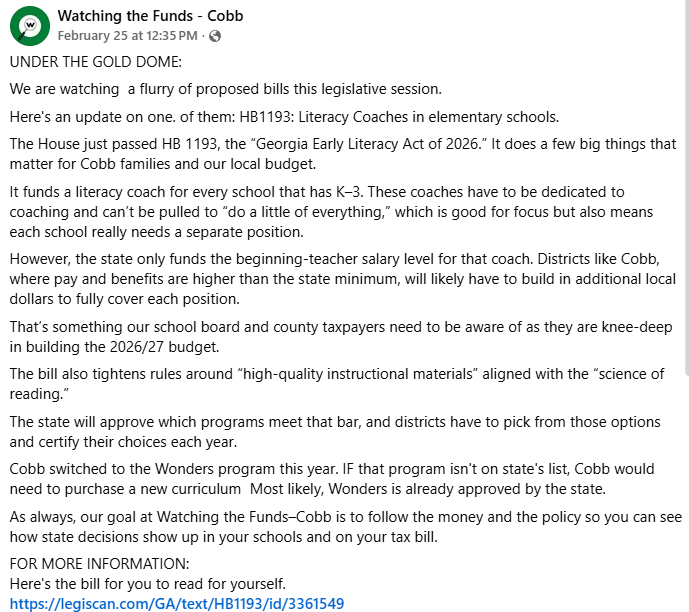
The Facebook post from “Watching the Funds – Cobb”, a group following education policy and its effects on local schools and budgets, defines HB 1193 and debates how literacy coaches will be funded and what the policy could mean for districts like Cobb County. By providing distinct details about funding levels, curriculum requirements, and local effects, the account establishes itself as a trustworthy source for understanding the policy beyond simple headlines. Posts like this show how social media can help communities follow legislative updates and understand how education bills relate to broader goals of improving literacy, classroom results, and overall student success.
https://www.facebook.com/groups/468501163820726/permalink/1848092172528278/?rdid=RG8ST5vK3gicyecG
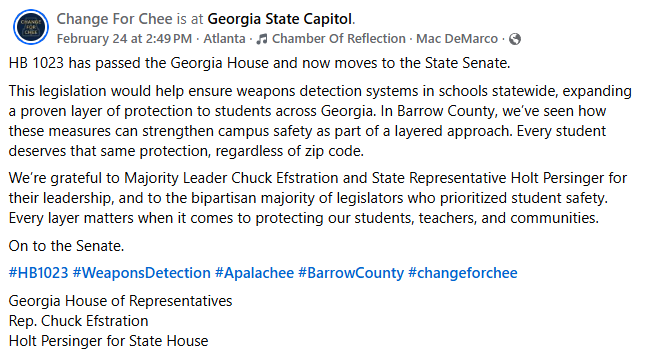
This Facebook post from Layla quoting Change For Chee is about the passage of HB 1023, a bill focused on improving school safety by mandating weapons detection systems in schools. The message emphasizes protecting students and communities, framing the legislation as part of a layered strategy for school safety. By thanking lawmakers and celebrating bipartisan support, the post encourages public engagement and understanding about the progress of the bill. When HB 1023 is paired with other education policies like HB 1193, which focuses on literacy, and HB 1009, which addresses classroom distractions, the multiple policies can work together to support both student learning and safety. Social media accounts like this help advise communities and keep the public interested in ongoing policy debates.
https://www.facebook.com/people/Why-not-our-Schools/61565704926400
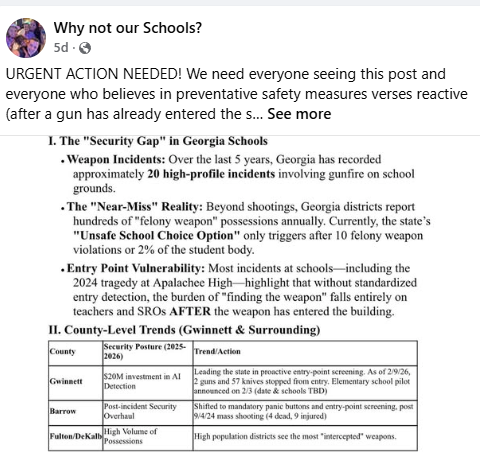
This Georgia parent implores citizens to tell their representatives to take action to pass House Bill 1023, which would add metal detectors to every level of schooling. They use the knowledge of civil rights leaders to increase the pathos in their post and speak to how ordinary citizens can change history by calling their representatives. They also show authenticity through their kids being in their profile picture to further prove how they want to keep Georgia children safe in schools. HB 1023 passed by House on February 24th.
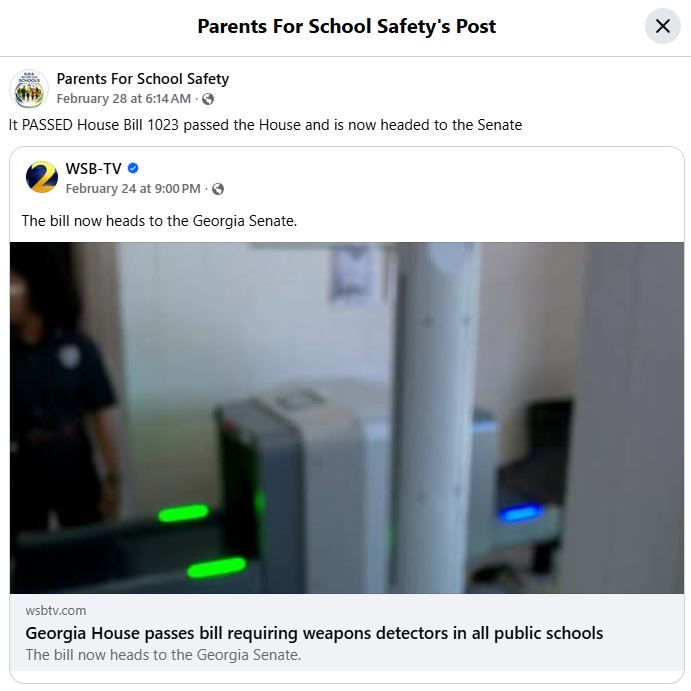
Nonprofit organization Parents for School Safety neutrally explain House Bill 1023, sponsored by Rep. Check Efstration (R), which would require metal detectors at main entry points of schools at every level. The nonprofit also provides a link to find one’s legislator to contact them about supporting the bill, passed by the House on February 24th.
Georgia parent Nisha Guisto expresses disapproval on the Pooler Community Facebook board over House Bill 1009 , which would ban the usage of cellphones in high schools. Guisto expresses concern over how to reach her child in an emergency and will not support the bill unless student safety measures are put in place. This post demonstrates Guisto’s authenticity as a parent and why other parents may also disagree with HB 1009.
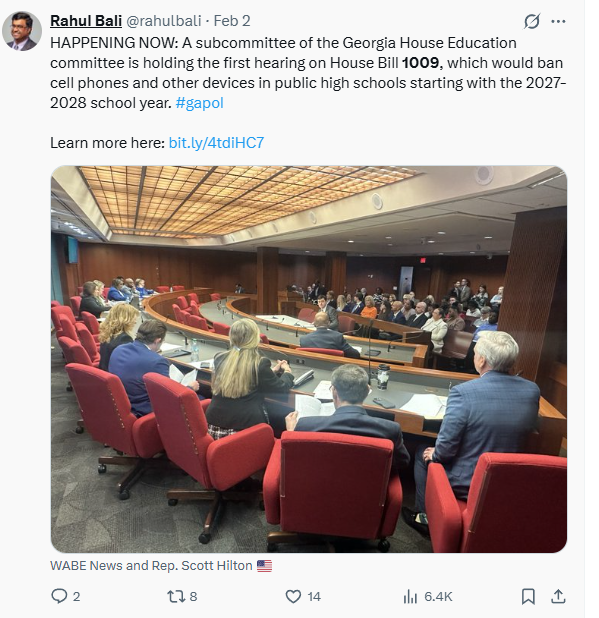
https://twitter.com/rahulbali/status/2018407586664419474?s=46
WABE reporter Rahul Bali provides a neutral report on House Bill 1009 . This tweet links to a WABE article on the introduction of the bill, written on January 16th and updated after the bill was passed on February 24th. Bali also uses #gapol, commonly used by Georgia politicians and reporters alike on X.
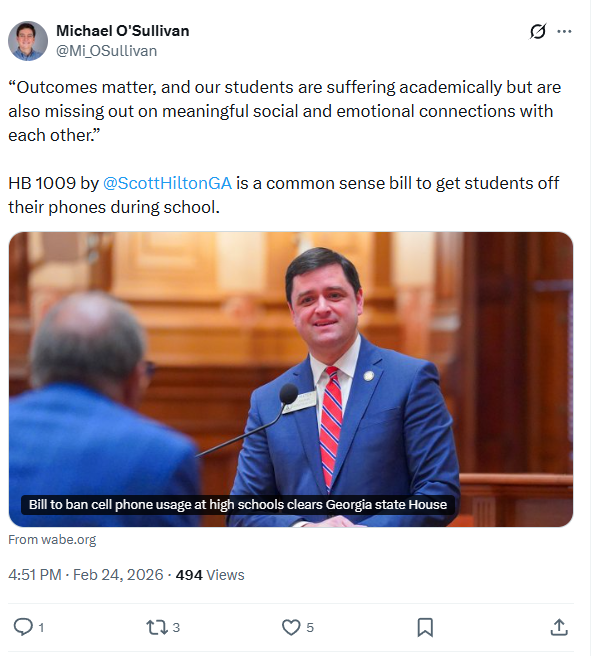
https://twitter.com/mi_osullivan/status/2026459990408441914?s=46&t=ySS9gSw4cza-5ZQYljVMRA
Executive Director of nonprofit organization GeorgiaCAN, Michael O’Sullivan, expresses interest in House Bill 1009 and gives accolades to Rep. Scott Hilton through Hilton’s quote and his own words for sponsoring the bill that will, in turn, increase the literacy levels in school children and advance their social skills
Education reform in Georgia shows how multiple policies can work together to improve student success, safety, and overall wellbeing. Through the discussion of House Bills 1193, 1023, and 1009, it is clear that lawmakers are focusing on different parts of the education system at the same time, including literacy development, school safety, and reducing classroom distractions. The sources we analyzed, especially from social media and community voices, demonstrate how these policies affect not only legislators but also parents, teachers, and students across the state.
We can see that public opinion plays a large role in shaping education policy. Supporters believe these bills will help students perform better academically and feel safer in school, while others worry about funding, personal freedom, and communication during emergencies. This shows that education reform is not simple, and every change can have both positive and negative effects depending on the perspective.
Reform takes time and effort, and Georgia is in the deepest form of reform it can be.
Leave a Reply