
CA1 Team 2

Photo by Tabius McCoy on The Atlanta Voice
The buzzword for this year’s legislative session at the Georgia General Assembly has been “affordability.” Politicians have focused on introducing, amending, and passing an array of bills aimed at keeping more money in Georgian’s pockets. One of the most prominent ways politicians want to approach this issue is through tax reform, particularly property and income tax. Some prominent bills include HB 973, a supplemental budget bill to redistribute part of the state revenue to residents and state-funded programs, passed on March 3rd; HB 1001, which aims to lower the income tax rate ahead of a previous projected timeline; and SB 476 and SB 477, also aimed at lowering the income tax rate and raising the standard deduction for taxpayers. With Crossover Day being on Friday, March 6th, many of these bills are either being quickly acted on or getting prepared to be discarded for this session. This article on Crossover Day by CBS News provides more context on the key takeaways of current legislation as we begin to approach the end of the 2026 session. Many residents have expressed relief and support for bills like these, while others, as well as some politicians and specialists, cite concerns about state funding and budget holes the legislature would create, with no plan in place right now to supplement the revenue lost from the tax reductions. The focus of these bills is to provide relief to Georgians during a time of increasingly higher cost of living through budget adjustments, redistributions, and new guidelines for spending. While representatives in the General Assembly seem to be split on what this would mean for other tax categories and state-funded programs that rely on that revenue in the following years, it is clear that Georgia residents have their own opinions on taxes and how revenue should be used. This post aims to provide more context on current legislation targeting income and property taxes, while also showing residents’ perceptions and opinions of the state’s efforts to increase affordability, and other related grievances they have.
Click Image to See More
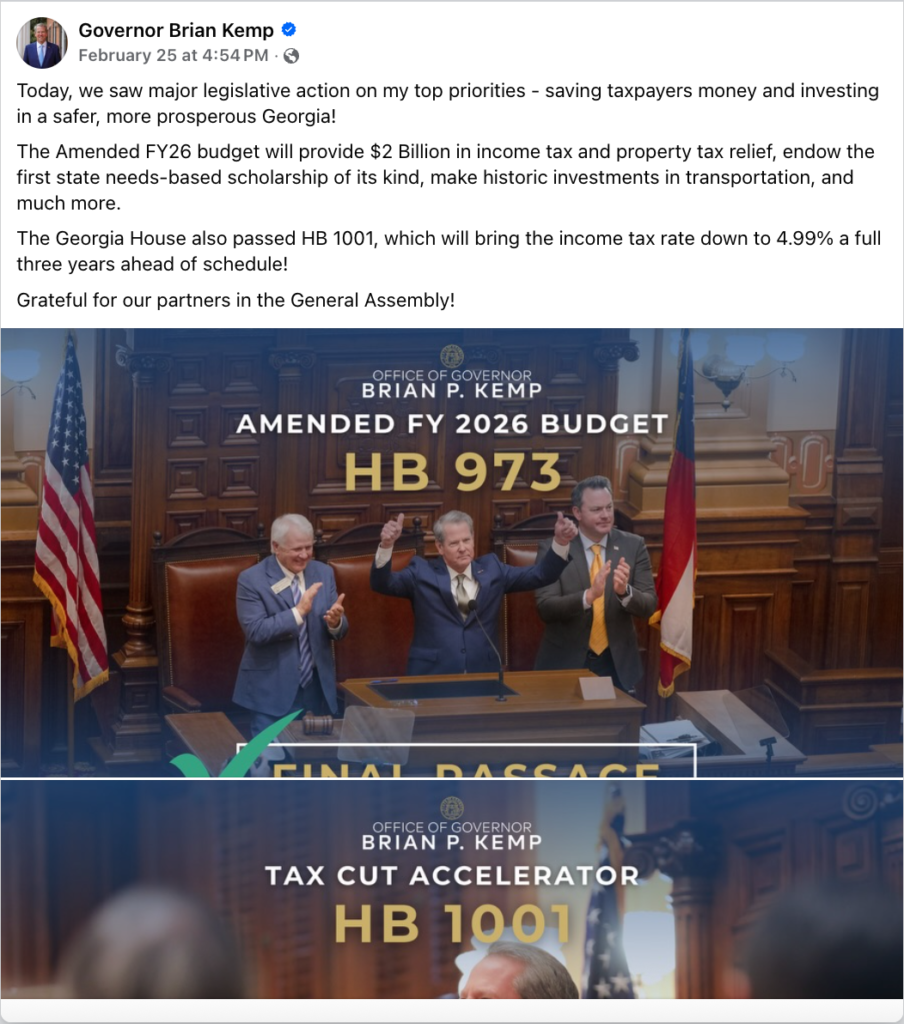
This Facebook post by Governor Brian Kemp celebrates the passage of HB 973 into law and the passage of HB 1001 in the House, moving over to the Senate. In the post from February 25th, Kemp remarks that “Today, we saw major legislative action on my top priorities – saving taxpayers money and investing in a safer, more prosperous Georgia!” This provides insight into the way the current Georgia Government is highlighting legislation and progress in economic change, particularly to increase “affordability.” The passage of HB 973 will effectively modify the existing state budget to redistribute $2 Billion in tax relief and create a first-of-its-kind needs-based state scholarship program, amongst other things. The Capitol Beat published an article that details how taxpayers will benefit from the passing of this bill. While Kemp’s post appears to be entirely celebratory, the comments are divided between people showing support for the bills and the governor, and others are more skeptical about the way the bills will be implemented and overseen. A top comment by Krissy Jean Marrall reads, “Will there be accountability and oversight?” Others celebrate Kemp’s efforts and ask for progress in alternative bills that also provide tax relief. Social Media posts like this make it easy to get a look into policy, stakeholders’ reactions, and discourse at the same time.
Click Image to See More
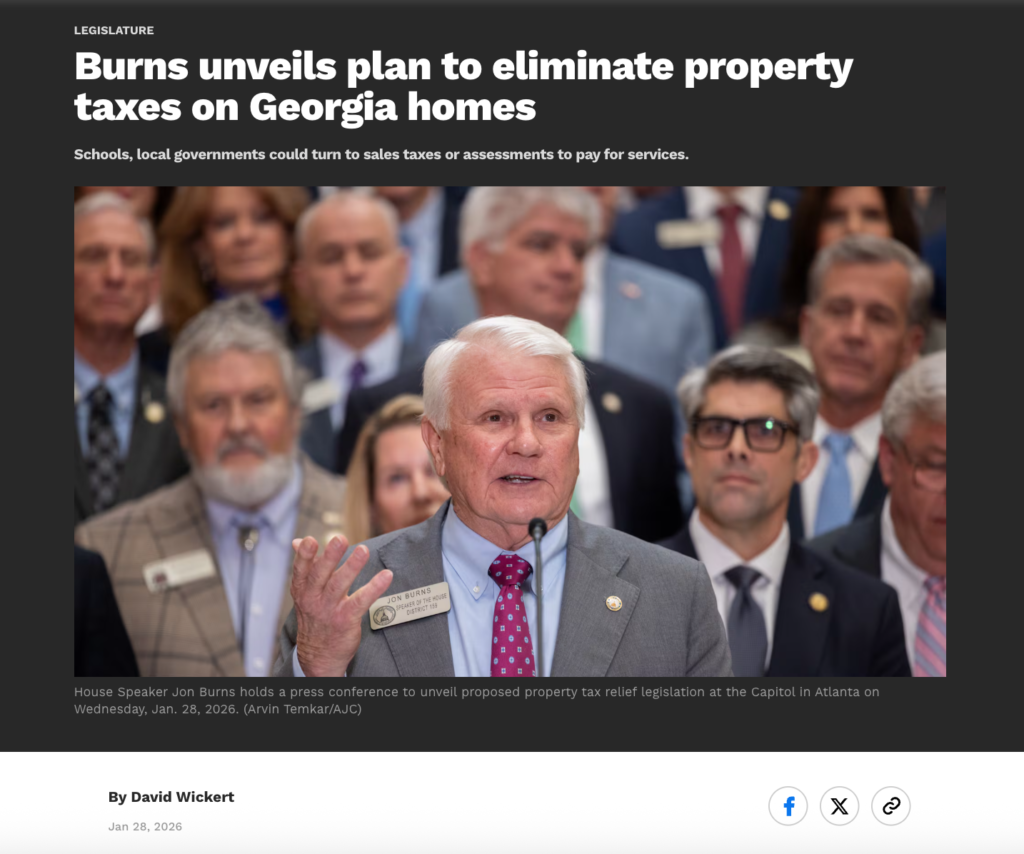
This article from January 28, 2026, by David Wickert goes over House Speaker Jon Burns’ plan to eliminate property taxes on single-family residences, with a plan to phase them out from 2027 to 2032. Property taxes are currently the primary funding source for public schools and services in Georgia, and this bill would eliminate more than $5 Billion per year for these funds. As an alternative, the bill proposes that schools and services repurpose existing sales taxes and begin charging assessments for operations, based on their cost. The reasoning for a bill like this, Burns explains, is to protect homeowners from losing their homes for not being able to pay high property taxes. He explains that “Georgia House Republicans believe no one should ever face the loss of their home because they can’t afford to pay rent to the government.” More on his comments about the bill can be found here. This bill is likely to be favored over bills aimed at eliminating the income tax, as this AJC poll from 2025 shows that while republicans strongly support getting rid of income taxing, while most democrats oppose it, voters on both parties strongly favor property tax reform over scrapping the income tax. The different bills proposed, as well as the poll, show how many different avenues there are for trying to make Georgia more affordable for residents, and different politicians are trying to explore every one of them to increase their chances of making tangible change happen.
Click Image to See More
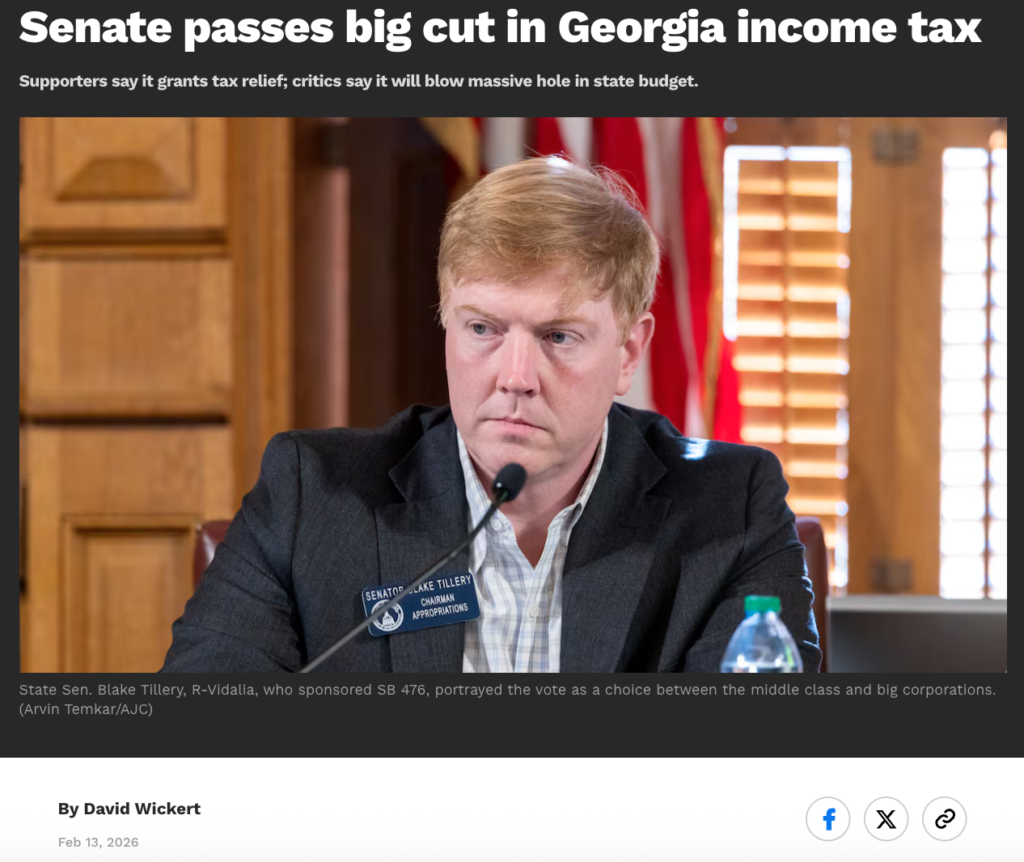
The AJC article written by David Wickert on February 13th of 2026 details two major senate bills that will refine taxation in Georgia for nearly all residents. Early into this year’s session, Republicans have been pushing for affordability within the state. This includes bills phasing out property and income tax. SB 476, which was written by Blake Tillery (R-19) and proposed by governor Brian Kemp in early January. SB 476 as described in the article will reduce income taxes for Georgians from 5.19% to a 4.99% rate and will cover its first year by trimming 2.8 billion dollars worth of tax breaks. SB 477 is also mentioned in this article as another option for another tax relief bill, as it claims to allow reductions of over 2,000 dollars and is also mentioned reducing taxes by 1% from now to 2028. However, both SB 476 and SB 477 have caused debate across the aisle as many Democrats including Kim Jackson (D-41) notes that the reduction of income tax will rise the price of sale rax which will cause a bigger wealth gap between Georgians and mitigate the republican’s push for affordability in the state in the next coming 5 years.
Click Image to See More
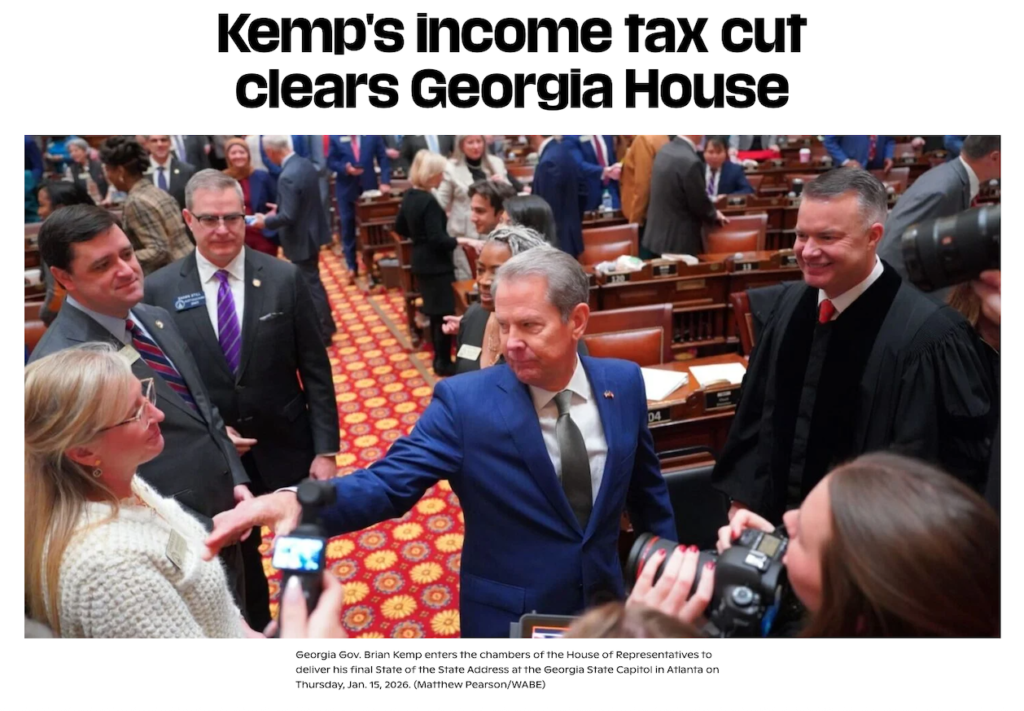
This WABE article written by Ty Tagami on February 26th talks about SB 476 again but in a new night as it continued to make its way to being passed by the legislature as the state house moved it along to be official into state law. When HB 1001 was passed the sentiment on the republican side of the aisle was that the Georgia population deserved their money that may have previously been controlled by the government. Again, one of the biggest arguments against the bills that are on the verge of being passed is the fear of georgians who are in lower income housing being forgotten about due to the rise of sale taxes due to the lack of funds that usually income and property taxes give to public institutions like schools, libraries, and public transport. Due to concerns raised by democratic leaders like Sam Park (D-107) House majority whip Will Wade (R-9) argues that the bills would help more income fall into the pockets on residents and that before the passing of the bills mentioned that republicans make sure that publicly used systems have been supported like law enforcement and schooling. With the article presented there are concerns that lead to worry that many georgians also find to be questionable due to funding limitations.
Georgia resident ( @TheOldWeirdPro) responds to“Everything Georgia” post that details how Georgia lawmakers are promising 1.2 billion in tax rebates and 850 million in tax relief on private property for Georgians. While many responses seem happy about the prospect of monetary gain from the new state laws would give residents there are many including @TheOldWeirdPro find the bills to be lacking benefit. He writes that Georgians deserve to be be fully covered with health insurance with the money that is being reserved for the elimination/reduction of property and income taxes in the next few months to a year. The concern that many voices raise on social media and democrats in the house is where is the money coming from and how will that create issues with needed services like healthcare. Another Georgia resident by the name of David Anderson responds to Tillery (R-19) who has sponsored and written most of the bills detailed in the “Everything Georgia” tweet ask what will be taxed instead of property and income? Both of these tweets coincide with the concerns of raised prices in other areas that leave residents unprotected in areas that are increasing their pricing due to the taxes on property and income being eliminated creating a gap of income for healthcare and infrastructure.
Click Image to See More
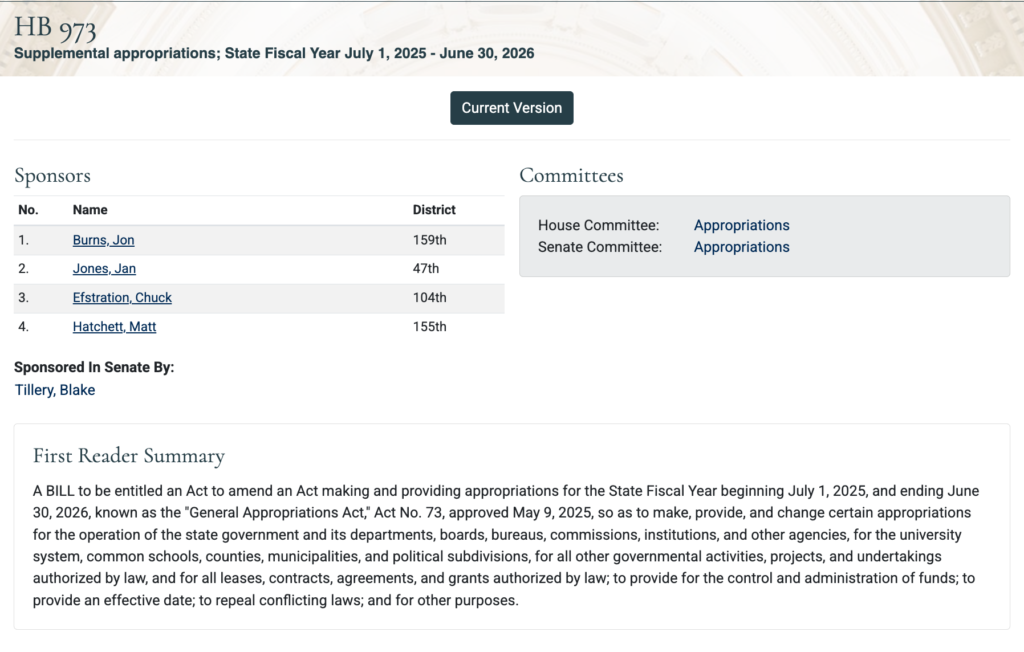
HB 973, which was signed into law by Governor Kemp on March 3rd, 2026, in the amended Fiscal year 2026 budget, basically involves the moving of $2 billion dollars by legislation back to residents in forms of either property tax relief or income. The bill had 4 main sponsors and has had a long history throughout its time starting on January 15th of this year. It is clear that with this bill, there is a desire to not only return money back to homeowners, but there is also a desire to save homeowners money like other bills in the Georgia Assembly currently such as SB 392, which makes agencies explain and justify their need for money instead of simply taking money from taxpayers. HB 973 addresses many topics in the state of Georgia and provides many benefits and details addressing each one. These include the already mentioned $2 billion dollar return to residents by legislation, major investments into transportation and infrastructure, as well as investments in public safety and mental health, and education and workforce. Many people have given mixed opinions on the passing of the bill as comments on Governor Kemp’s post on X discussing the passing of the bill, have met the bill with rather negative responses, while others such as Dorothy Harpe gave the bill praise on X stating “Georgia taxpayers get a relief, thumbs up Georgia”.
Click Image to See More
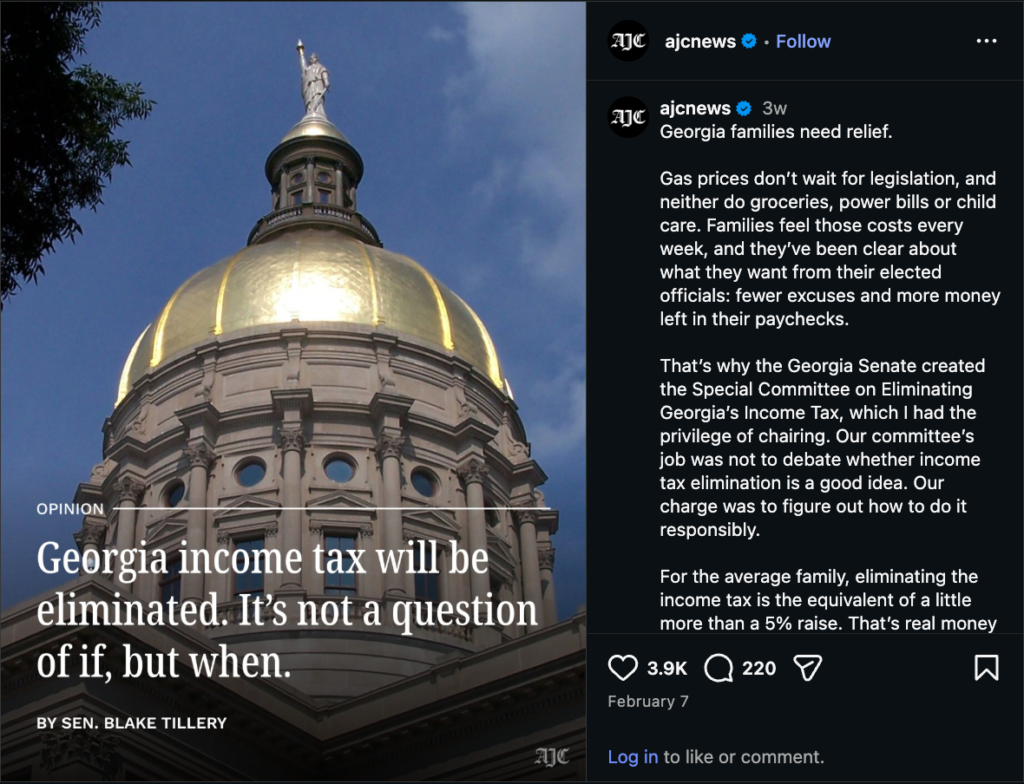
A post on Instagram from the AJC looks into the opinions of a Georgia senator, in this case senator Blake Tillery who believes the end of income tax in Georgia is imminent. He uses the people of Georgia to show how families need relief stating that “Gas prices don’t wait for legislation, and neither do groceries, power bills or childcare. Families feel those costs every week, and they’ve been clear about what they want from their elected officials: fewer excuses and more money left in their paychecks”. Tillery uses Georgia residents as his biggest reason for his push for the elimination of the Income tax in Georgia. A post from Tillery on X sees him go into further detail, revealing a gameplan he has made, consisting of the increase of the standard deduction for Georgia filers to $50,000 for individual filers and $100,000 for joint filers going through to 2027. This plan directly relates to the 4 bills passed by Georgia senators which would begin limiting the state income tax in Georgia. Tillery makes it clear he is a major supporter of eliminating the income tax in Georgia and calls to not prevent residents from waiting and move quickly to eliminate it.
A post from the Everything Georgia X account discusses the approval of a Fiscal Year 2026 state budget by Georgia lawmakers. The budget would include 1.2 billion dollars in tax rebates along with 850 million dollars in property tax relief, providing 2 billion dollars in tax relief for Georgia residents. The bill was heading to the desk of Governor Brian Kemp and on March 4th, the bill was passed by Governor Kemp as seen in a post on X by the Georgia Press discussing the bill. While the initial reaction has been rather small from residents from Georgia, the reception has proven to be rather positive, as the grand majority believe this will be a step in the right direction as they will be getting money back. Governor Kemp makes a statement on the matter that can be found on the Georgia.gov website stating, “The amended budget I’ll sign today delivers meaningful relief to the people of Georgia while also making key investments that will drive our state’s success for years to come”. With that being said, it is clear Kemp is looking at both long term success of Georgia, as well as providing relief Georgia residents have been wanting.
A post on reddit regarding the proposal of a 1 billion dollar tax rebate, lower income tax, and need-based scholarships by Governor Kemp mainly consists of comments and opinions made by people regarding these ideas. The comments on the Reddit post are entirely mixed as while some are optimistic about the proposals made by Kemp, others are more negative about it pointing to other issues in Georgia that they feel Governor Kemp should be focusing on. Some of the major topics discussed in the comment section of the Reddit post include improving Georgia’s school system, housing, healthcare, transportation, and more. The post on Reddit showcases the division the proposals and bills in the government can cause in a state as it can cause both positive and negative reactions from residents. In this case, the proposals made by Governor Kemp are a prime example of mixed reactions from Georgia residents as seen on Reddit. While the proposals he is making regarding the tax rebate, lower income tax and having scholarships that are need-based, there will always be a different topic that is discussed by residents that they feel is important and should be discussed as seen through comments of users on the Reddit Post.
Stephanie Zaenker’s post on X regarding property tax reform shows her eagerness for change in Georgia. In the post, Zaenker pushes for a property tax reform to happen immediately, along with limits in tax and truth in taxation. This comes as a response to a post on X by Tony West discussing a post from the AJC stating that property tax reforms are being moved and that in his opinion “The final compromise version must include two things: 1) an airtight levy limit–whether it is property taxes, or other types of taxes and fees, the total level of taxation at the local level should be capped”. Posts from people like Stephanie Zaenker highlight the eagerness and demand people have regarding topics in the world of politics. Now more than ever, people are demanding change in the world of politics and some such as Stephanie Zaenker are demanding for change immediately. This is a similar situation to comments on an AJC instagram post about eliminating income taxes. In the comment section, there are many examples of users demanding for eliminating income tax such as @derylishere saying that “this should be voted on”. Stephanie Zaenker makes a pretty bold statement regarding what should be done in Georgia and exemplifies the desire of many residents of Georgia to see change occur in their state.
In conclusion, the documents that were analyzed by our team show how there is currently an ongoing major debate currently in Georgia over tax reform at the moment. Rather it be residents of Georgia, stakeholders, politicians or journalists, each group has a different perspective and opinion and are building the debate currently happening in Georgia right now. As political figures such as Governor Kemp look at tax reform as a way of returning money to taxpayers as well as a way to improve the overall affordability in Georgia, there are many who are quick to call out the flaws of the idea of tax reform by pointing out that it could have negative impacts in the long run. The differences in opinions and perspectives between residents and political figures further exemplify the ongoing division regarding the policies of taxes. The current ongoing tax reform efforts in Georgia are surrounded by debates and discussion, primarily due to how it illustrates the influence of economic policy not only from lawmakers in Georgia, but from the opinions of residents, digital communication platforms, and public advocacy that are allowing for stakeholders to have their voices be heard in regards to any concerns or support regarding change.
Leave a Reply