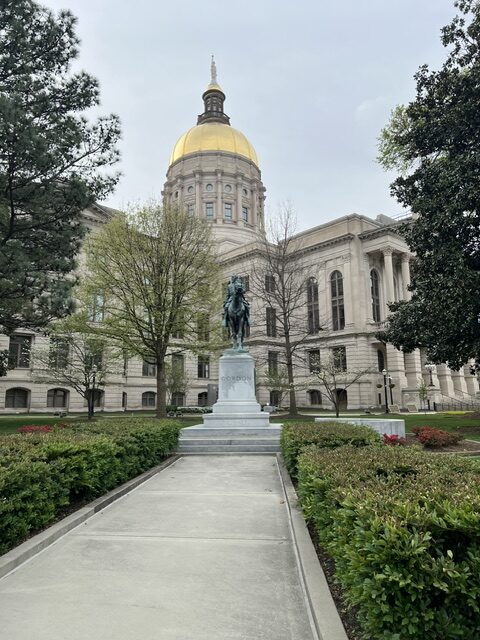
CA2 Team 1

Photo by Calvin W.
CA2 Team #1:
Jacie T, Katherine N,
Calvin W, Alexander E
Zombie bills are nothing new within the realm of law, bills that undergo changes and are most often inserted into other bills either as amendments or entirely new sections of an existing bill, many of which are often scrutinized and called out for the feeling of deception they can bring. House Bill 369 in Georgia is no exception. A bill originally intended to set an equipment standard for motor vehicles used in the transportation of food and beverages, now with additional changes later in its language to repeal conflicting laws, and eventually to create a new bipartisan election system for five counties within Metro Atlanta. The reactions to this bill having been passed on Sine Die, nearing the end of the legislative session, now coming to sit on Governor Brian Kemp’s office desk, have been varied, though many of which comment on similar issues to other zombie bills. Several stakeholders and politicians have voiced their concerns over this bill already, four years before its effective date of 2028. These concerns vary from a lack of clarity on why it was needed, to some pointing out commonalities in the counties and more specifically the positions the bipartisan elections target, as well as others making their voice known on their position in regards to the bill. Here we will go into some of these voices, what they have to say, and what exactly they are referencing with their statements, as well as the reporting on what exactly this bill aims to accomplish in regards to these concerns.
_____________________________________________________________________________________________________
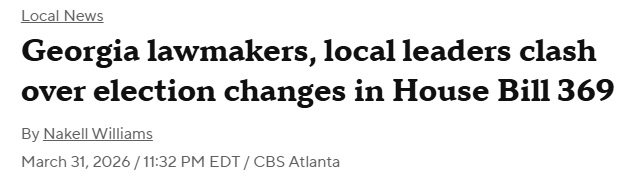
Nakell Williams, the author of this article, published on March 31st, begins by informing the audience of what the topic at hand is: House Bill 369. According to Nakell Williams, that would change how local leaders in metro Atlanta, specifically in five counties, would appear on the ballot. Nakell goes out of her way to outline some of the pushback, showing quotes and data collected in regards to this bill, which we will go into more detail about in later artifacts. Nakell highlights numerous important observations in regards to this bill, such that it targets women of color in specific offices and that it only applies to a few outlined counties rather than the entire state. She also outlines the comments of one of the senators who supported the bill, claiming that the bill was “common sense legislation”. Nakell Williams also outlined that several of the sponsors and legislative leaders were unavailable for comment or had not responded.
“Once black communities are winning and being equally represented, some try to change the rules instead of respecting the results.” – Mo Ivory’s TikTok
Mo Ivory, the Commissioner for Fulton County, posted a TikTok talking about HB 369 and how this bill goes further than to take (R) and (D) off ballots- it is a voter suppression bill. A major controversy of HB 369 is the targeting of certain districts, not the entirety of Georgia. As Ivory states, the five districts this bill is applicable to are the largest and most diverse counties in Georgia. Targeting only these five districts, black and marginalized communities are at risk of less representation, and all efforts of representation are diminished. Ivory points out that once black communities are winning and being equally represented, some try to change the rules instead of respecting the results. By limiting the powers while voting, HB 369 could ultimately change the way Georgia swings within national elections due to its targeting of the metro Atlanta area. Due to a shift in Georgia’s diversity and economic strategies, Atlanta’s suburbs have contributed to changing political allegiances (Agnew & Shin, 6). Therefore, Georgia is vital in determining electoral votes for national elections, and HB 369 can prevent fair elections.
The rise of AI-generated images is a common way to make a situation comedic, as Holly Kesler does in her X post about HB 369. By directly commenting on Fani Willis’ reaction to HB 369, Kesler had to make a comical image for this one because Fani is BIG mad! Fani Willis is the first black female District Attorney for Fulton County, Georgia — a county that will be directly impacted should HB 369 be implemented. The goal of HB 369 is to eliminate party affiliation on ballots for District Attorney, County Commission, Tax Commissioner, and School Board starting in 2028, making these races nonpartisan. As the visual Kesler created shows, this bill is indirectly aimed at the five counties HB 369 is targeting, and the five DAs of the counties are all black women. With closer examination as we watch the future of this bill, we cannot ignore the undermining of black female power in political positions.
“HB369 went from Motor vehicles; sale of food or beverages; provide vehicle equipment standards to a proposition to making elections non-partisan for 5 Georgia counties out of the 159 counties we have? This is ridiculous. That’s why I keep paying attention to local politics. Local government matters!” – Montina Young Fraiser comment on LinkedIn
Montina Young Fraiser’s comment highlights the monumental changes that HB369 underwent to become an election-related bill. If we look at the past versions of the bill, such as the “LC 39 4710S/HCS” version, we can see that the bill was supposed to require food trucks to have extra safety features. With the bill undergoing such an extreme change, it makes some, such as Fraiser, uneasy because it may feel deceptive. Even the Georgia General Assembly website still summarizes the bill as if it is related to motor vehicles.
Fraiser’s comment also highlights one of the major criticisms of the bill: equitability. Fraiser’s comment is essentially saying that, because the policy only affects five counties, it is not equitable and is therefore problematic. Fraiser is not the only one who criticizes the bill because of its limited reach. In the WABE article, “DeKalb County district attorney warns of legal fight if HB 369 becomes law”, Tiffany Griffith mentions that some critics think the bill is specifically targeting Clayton, Cobb, DeKalb, Fulton, and Gwinnett Counties because their district attorneys are African American Women. If true, this would imply an intentional attempt to rig elections to sabotage a specific party and demographic.
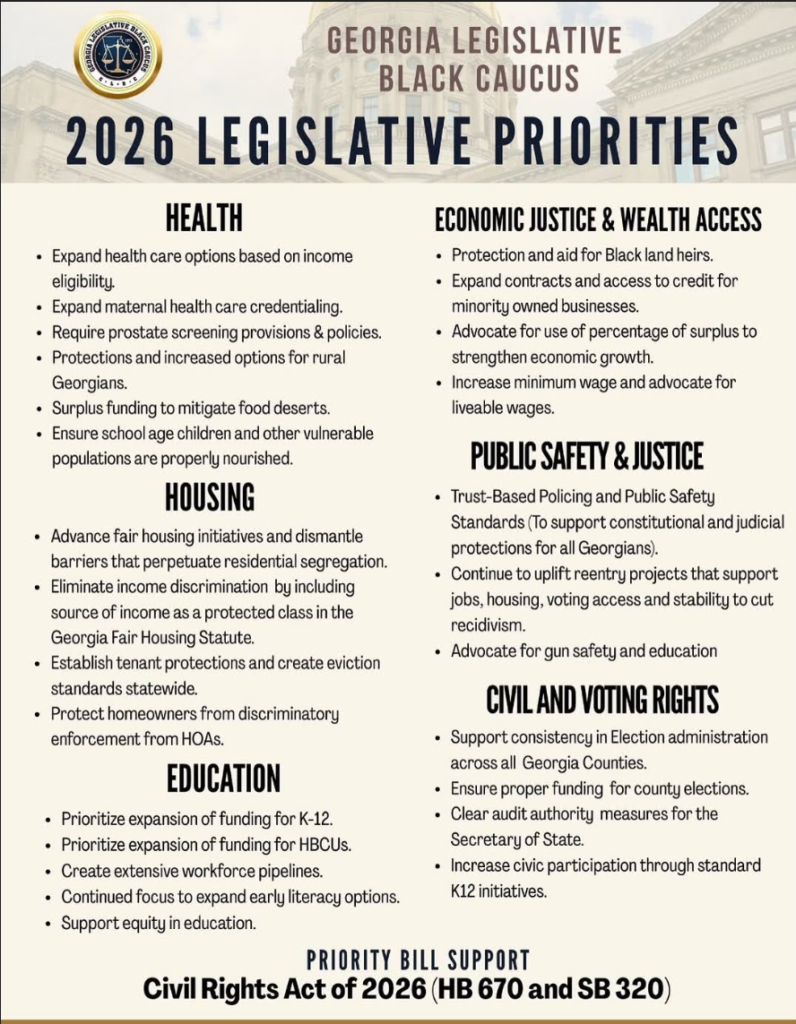
Credit: ga_blackcaucus account on Instagram
On February 17th, 2026, the Georgia Legislative Black Caucus posted an overview of “legislative priorities”. The post was intended to draw attention to issues that Georgia residents needed to pay attention to. As can be seen in the post, one such priority is to “support consistency in election administration”. From this post alone, we can assume the ga_blackcaucus organization would be against HB369, a bill that changes election procedures for very specific officials and only 5 Georgia counties (the truth of this assumption will be covered later). What is significant about this post is that it calls for election consistency, and by doing so, it reflects an existing concern of inconsistent elections in Georgia. Overall, election legitimacy and election policy have been significant issues during this legislative session, and HB369 has transformed into another facet of an ongoing push to adjust election policies (for better or worse). Organizations such as the Georgia Black Legislative Caucus are advocating for any such policy changes to not only be consistent but to improve the election process. The question then becomes, if HB369 were a consistent policy and was applied to the entire state of Georgia for elected officials, would that be a positive or negative policy? Would voters be more or less educated going into the polls?
This is a post on X from William Boddie, a 2026 candidate for the Georgia Senate. Like many other people discussed in this post, he’s an advocate for metro Atlanta who’s urging Governor Brian Kemp to veto House Bill 369. What separates him from the other advocates in this post is that if the bill is passed, if elected, he can help prevent this bill from ever going into effect before 2028. In this post, he says he does not support this bill because it’s unfair that 154 other counties would not be subject to this change on their ballots. He urges that this bill is Unconstitutional due to the Equal Protection Clause of the U.S. Constitution, further showing why he is speaking out to get this bill vetoed. If HB 369 is passed and Boddie is elected, he will be able to sponsor or vote for new legislation that could prevent HB 369 from having an effect on the 5 metro Atlanta counties. He could also have a say in any other zombie bills that might be pushed through the Georgia legislation in the next General Assembly. We included this because it’s important to know that representatives running in this next election want to prevent these misleading bills from slipping through the cracks of our state’s legislation.
In this post from X, Ed Williams discusses the issues with House Bill 369 in a letter he sent to Brian Kemp and urges users who see the post to do the same. The first issue mentioned is how District Attorneys are state judicial branch officers, not county officers. Meaning this affects the state as a whole, not just the counties they’re elected out of. The bill essentially creates two different election systems for the same class of state officers. The second problem brought up is that it violates Article IX of the Georgia Constitution by not imposing nonpartisan elections statewide. Stating that they shouldn’t be using the most diverse and highly populated counties in the state as a guinea pig for nonpartisan elections without a constitutional justification. The third issue talked about is how the counties being targeted are all counties that currently have African American women as their DA’s. It also mentions that the bill hides information from voters in the counties with the highest population and most complex elections. The biggest issue highlighted in this letter is that if this bill is passed to reduce “political games,” then why would it only target the most densely populated counties in the state? Ed Williams posting this letter is an example of how to really use social media platforms to make a difference. Instead of just sending this letter to Kemp, he allows many others who see this bill as an issue to also contribute to possibly getting it vetoed.
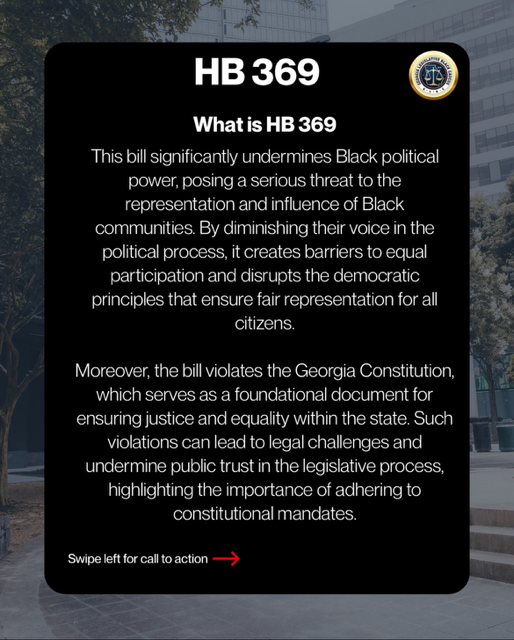
“GEORGIA HB 369 is unconstitutional and disrespecful to Black Leaderhip in Clayton, Cobb, DeKalb, Fulton, and Gwinnett.” — ga_blackcaucus.
A challenge with HB 369 is the direct violation it causes to the Georgia Constitution. Two major foundations of the Constitution are to uphold equality and justice within the state. HB 369, if signed by Brian Kemp, would not only void the Constitution but also break the one-subject rule and title consistency requirement, as stated in the Instagram post by ga_blackcaucus. Under Article III, Section V, Paragraph III, of the GA Constitution, laws must be limited to one subject clearly expressed in the title, and HB 369 fails this standard. By keeping a close examination of this bill, it is fundamental to see where the future of political affiliations lies for Metro-Atlanta. This Instagram post is one of many with a call to action for Brian Kemp to NOT SIGN HB 369.
Credit: Because We Care, Henry County Facebook
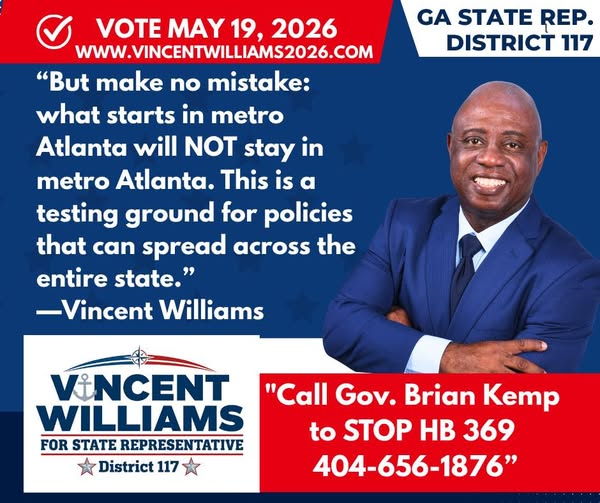
Vincent Williams is a candidate for GA House District 117, and the campaign post from the Because We Care organization implies that he opposes HB369. The campaign post is interesting for a number of reasons. First, Vincent Williams does not appear to be affiliated with any particular party. One might assume that making elections non-partisan would be appealing to a non-partisan candidate. However, as we can see, this post opposes that assumption, which indicates the unpopularity of such a bill. As indicated in the image, Williams’s opposition also originates from a concern that the policy would spread to the rest of the state of Georgia if passed. Such an idea is distinct from other criticisms, which argued that the policy was improper due to the restricted and inconsistent application of the policy changes. The description of the post states, “this bill strips voters of critical information they rely on to make informed decisions”. Williams’s argument provides a new perspective on HB369, which is that the bill will impair voters and complicate the voting process.
“Instead of providing clarity, this approach forces voters to rely on advertising, mailers, and outside influence rather than transparent identification of a candidate’s principals” – Georgia 9th District GOP on X
On X, the GOP for Georgia’s ninth district posted a statement regarding the issues with HB369. The party is specifically calling for Governor Brian Kemp to veto the bill. Such a statement is noteworthy for several reasons. First to mention is that this is an official branch of the Georgia republican party that is opposing the bill. This contradicts some articles covering the topic, which had suggested that republicans are in favor of HB369. One such article was “Which bills did the Georgia Legislature ultimately pass on Sine Die?” by Alessandro Marazzi Sassoon with Atlantic Civic Circle. Sassoon implies that the reason HB369 passed in the house and the senate is “Because Republicans think they can’t win DA elections in these counties with an (R) next to their name”. Clearly, the 9th distinct GOP would disagree.
The GOP for the 9th district has a similar issue with HB369 that Vincent Williams did. They argue that HB369 will effectively make it harder for voters during elections, instead of easier. The post implies that making elections non-partisan will either create ill-informed voters or force voters to analyze outside information and build knowledge about each candidate. Perhaps one could argue that the election policies in HB369 will cause people to vote across party lines, though whether that will be due to ignorance or education is unknown. The GOP believes it will be the former.
_____________________________________________________________________________________________________
In summary, House Bill 369 is a potential problem for the way Georgia counties elect their district attorneys, solicitors general, county commissioners, court clerks, and tax commissioners. Both parties see the risks that might arise if this bill becomes law. From how the bill is being disguised as a different one to how it only adds non-partisan elections in the counties with the most complex elections. The biggest concern is about fairness, because if non-partisan elections are really viewed as a needed change, then they wouldn’t have only applied them to the most populous counties. As explained, many stakeholders have pointed out the contradiction HB 369 has with the Georgia Constitution. This is why the stakeholders talked about are calling for Brian Kemp to veto this bill on his desk. Overall, this bill raises important questions about fairness, transparency, and whether voting laws should apply equally across all counties. Stakeholders need to keep urging Kemp to veto this bill that significantly affects diverse communities, particularly because the counties involved currently have Black women serving as district attorneys. William Boddie and Vincent Williams are people who can really affect the future of this bill if it is passed and they are elected. Georgia’s Black Caucus Organization is a stakeholder mentioned to watch who could engage and possibly help enforce changes to this bill.
Leave a Reply