
CA3 Team 1

Photo by Calvin W.
CA3 Team #1:
Jacie T, Katherine N,
Calvin W, Alexander E
Over the last few years, several bills across the country have cropped up and are passing late into the legislative sessions of multiple states. Several of these bills, like Kentucky HB 388 and Georgia HB 369, have contained language and intentions to remove political indicators of party from specific offices and elections. Several of these bills have received criticism as well as pushback both during and after their passing from both houses and senates in both of the mentioned cases. Numerous stakeholders and politicians have urged their constituents to contact their governors to veto these bills, as well as others reaching out amongst their followers to inform them of the nature of these bills. In light of these findings with these bills, there are others who are informing the people affected by the bills about how they can act to combat them, or at the very least stay informed of them. However, on the other side, there are those who support this bill, claiming a growing exhaustion of political involvement within the voting process. And outside of those two avenues, there are also those just seeking to inform their constituents and peers about what to expect when these bills become effective in the future. This article will go into greater detail and analysis not only on the Kentucky bill itself, but also into reactions to both bills and their similarities; be they for or against the bills, as well as those simply providing information in the form of social media and journalistic posts to the public.
_____________________________________________________________________________________________________
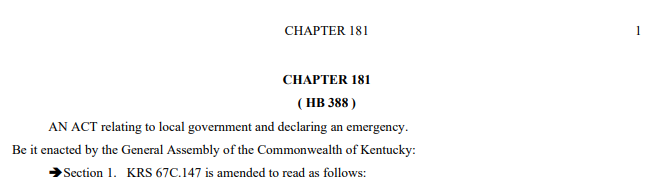
Kentucky House Bill 388, similarly to Georgia HB 369, requires nonpartisan elections; however, Kentucky House Bill 388 is intended for both the office of mayor as well as members of a consolidated local government council, whereas Georgia HB 369 is intended for 5 counties in Metro Atlanta and a few more specific positions. The Kentucky bill further stipulates that a nonpartisan election will be held to fill vacant positions as well. This bill from Kentucky was passed in April of 2024 and was effective starting in January of 2025, which means that it has been effective for the greater part of a year and a third. Georgia’s house bill was also passed in late March of this year, taking effect in January of 2028. The Kentucky bill received similar backlash as the Georgia bill, specifically from the opposition, citing similar issues as those brought up for the Georgia bill. This will be gone into further detail within this post
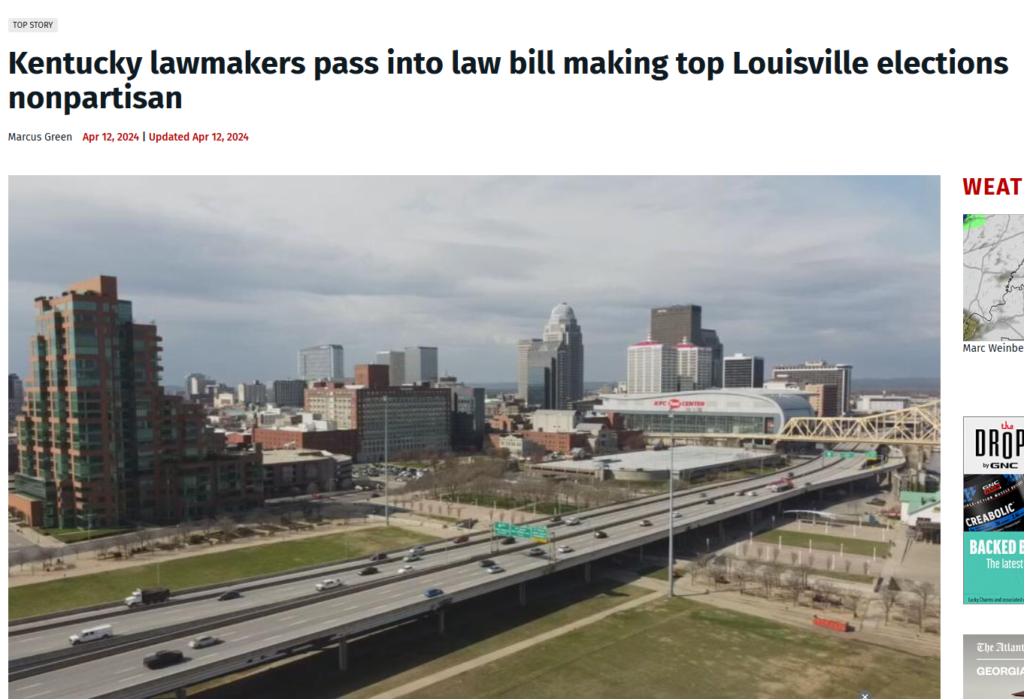
On April 12th, 2024, former reporter Marcus Green published the article “Kentucky lawmakers pass into law bill making top Louisville elections nonpartisan,” overviewing critiques and support of Kentucky House Bill 388 after state legislators overturned Kentucky Governor Andy Brashear’s veto of the bill. Green notes that supporters think that the bill is contributing to making the state more uniform with its election laws, while critics say the opposite. The critique is impressively similar to that of critics of GA HB369. As we see in one Instagram video from the Working Families Party (and covered in depth on our CA2 post) some Georgia stakeholders disapprove of HB369’s limited reach. In Green’s article, we can see the same issues were raised by the Kentucky Governor himself in regards to KY HB388.
“Those elections are gonna happen in May, instead of in November where you get to know who on the ballot is representing democrats and who is representing republicans” – Jasmine Clark Facbook
Representative Dr. Clark’s video is specifically trying to draw attention to zombie bills and uses Georgia’s HB369 as an example. She is explaining the effect of HB369 to raise voter awareness, which some believe may be reduced if HB369 is passed (even from across the political aisle). In the representative Dr. Clark’s quote, as shown here, she overviews what the change means for voters. She points out that people in the five metro counties will not be able to see who is a democrat and who is a republican in local elections, and that their standard election season has been changed. This is similar to how representatives for Kentucky are currently dealing with the bill.
“We’re responsible for making sure our elections board is balanced and representative” – Dana Barrett Fulton County Commissioner for District 3
An impact that HB369 has on Georgia elected officials is taking away the party affiliation on the ballot. By directly affecting the five most populated metro areas, district attorneys and commissioners are going to run as nonpartisans. As Fulton County Commissioner, Dana Barrett says that commissioners are the defenders of elections, enforcing balance and upholding representation. In Barrett’s Instagram post, she said if you don’t know who your commissioner is or how they’ll vote, you can’t hold them accountable for protecting your elections. It is important to note that the bill has faced controversy from party-to-party, as it is a Republican sponsored bill, yet we see even elected officials like Commissioner Barrett calling Brian Kemp to veto the bill. Other Representatives, like Rep. Sandra Scott (D), oppose HB369 because it is designed to confuse voters, dilute organized political power, and weaken the very coalitions that have allowed Black communities—and especially Black women—to lead, serve, and win. Specific targeting by Republican politicians of the most populous areas of Black voters shows transparent racism to dilute Black power.
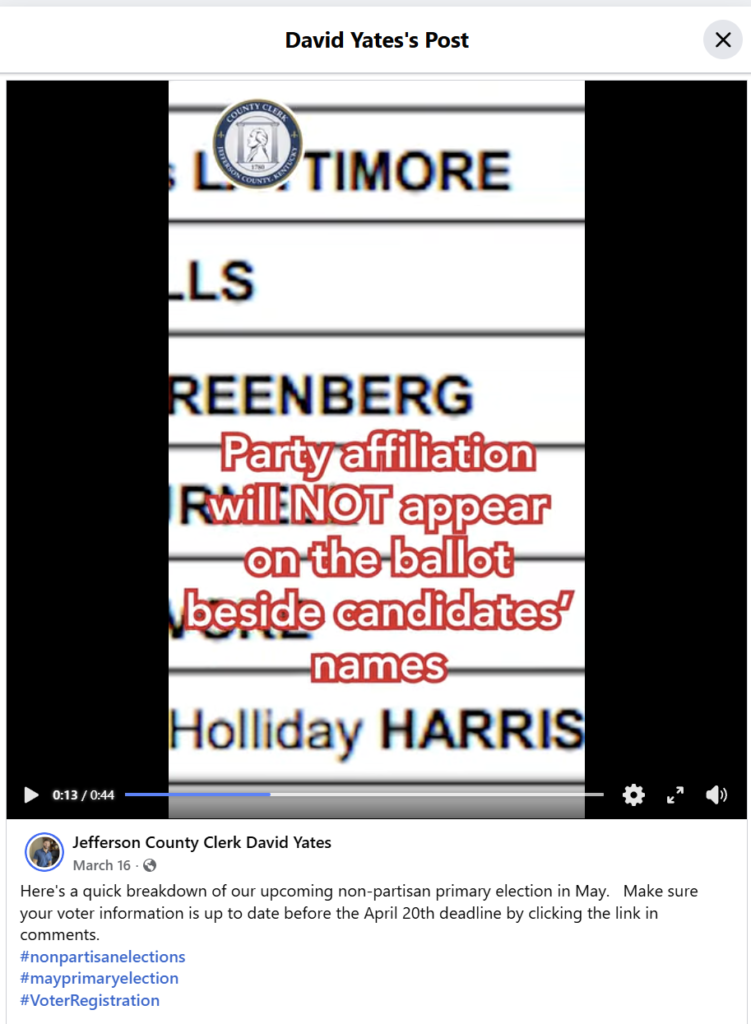
David Yates, a county clerk for Jefferson County, Kentucky, made a video specifically to showcase a sample ballot for an upcoming Louisville election, which is the first affected by KY HB 388. His video implies similar concerns to those of Representative Dr. Clark’s video. Through this video, Yates is attempting to raise voter awareness in a preemptive attempt to counteract the reduced voter awareness that may arise from the ballots being newly non-partisan. Just like in Georgia, many stakeholders had concerns about how KY HB388 would affect voter awareness, such as in this statement from the Louisville Urban League.
Alike Georgia’s HB369, HB388 in Kentucky targets the metro area of Louisville to change elections for mayor and council members to be nonpartisan on ballots. The sponsor of HB388 in Kentucky was backed by Representative Kevin Bratcher (R-29). As he was facing comments on the bill during the 2024 session in Kentucky, he addressed during the video that many people in his district support the idea of nonpartisan bills due to the fact that they are tired of political rhetoric all across America. However, there is controversy that the bill was hidden from the public and passed, even after going through a veto override process. On an X post by the Louisville Urban League, Louisville passed this bill with little public awareness or comment, which belittles the transparency and increases the secrecy of the government. When comparing this to Georgia’s HB369, which is a zombie bill, the two bills are nonpartisan-based and were given to the Governor to sign, with high rejection from the public.
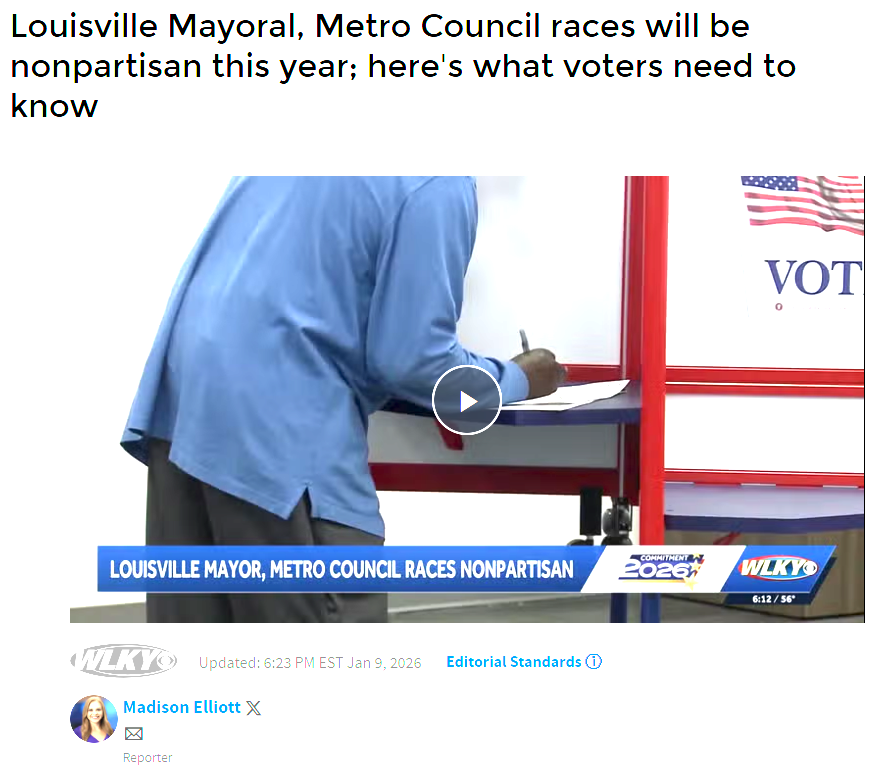
This news story from WLKY goes over the changes Kentucky’s House Bill 388 will have on the voters in Louisville and what they should expect. This is included in our article because, if Georgia’s HB 369 passes, this is the news story voters in metro Atlanta will see. The biggest difference between the two bills is what specific elections will be changed to non-partisan and the impact that will have. HB 388 will only impact the elections of Louisville’s mayor and Metro Council. There is a lot less online discourse about HB 388 because the non-partisan elections are only affecting a specific area, not the state as a whole. This news story might look like future stories in Atlanta if HB 369 passes, but given all the issues Georgia stakeholders and politicians have brought up, there is no doubt that metro Atlanta residents will continue to voice their opinions about the problems with HB 369.
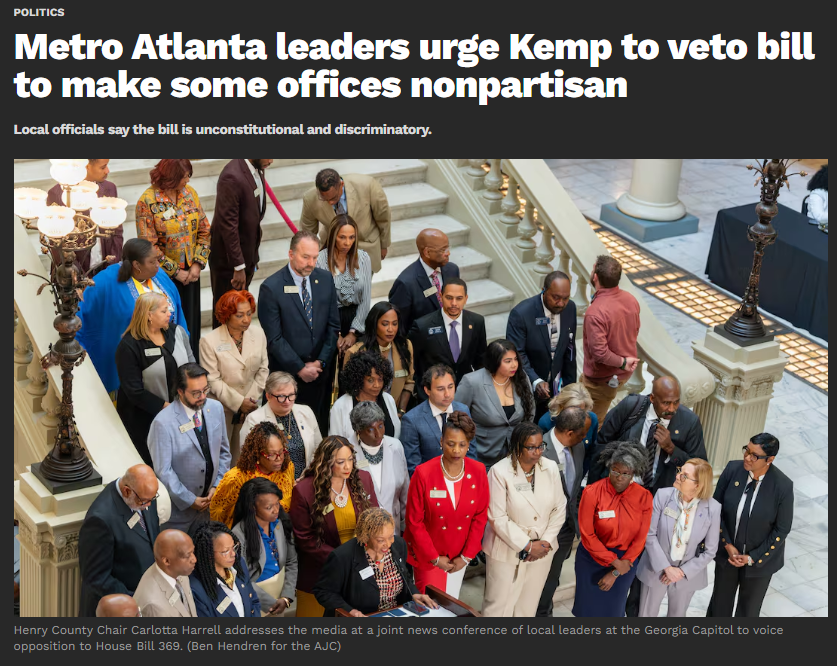
Caleb Groves with the AJC points out several of the supports and criticisms of Georgia’s HB369 that we have discussed thoroughly already, such as the injustice of it targeting specific counties and potential issues with voter awareness. Groves specifically points out the issues this may cause for democrats; however, it is not only democrats that have raised concerns about the bill. Republicans and even a non-partisan official have shared similar concerns. This differs from the coverage and response of KY HB388, which was supported enough by republicans to override Kentucky Governor Brashear’s veto of the bill. Still, the similarity of the situation is clear. In both states, people were/are against the bill and wanted it vetoed. One is forced to wonder what may happen if Kemp vetoes the bill. Will it play out as it did in Kentucky, in which the governor vetoed the bill and said the veto was overturned by Congress? Only time will tell
Cassie Lyles, running for state rep (D) D-30 in KY, talking about HB388 Instagram video
To understand exactly how HB388 affects elected officials in Louisville, Cassie Lyles, who is running for State Representative in House District 30 in Kentucky, posted this Instagram post explaining HB388. By addressing why the bill is important, Lyles shows that Kentucky has closed primaries. You can only vote for people who match your party’s affiliation that you selected. With the implementation of HB388, over 70,000 independent voters—people who selected independent party affiliation instead of R or D—are now able to participate in the mayor and metro primaries for the first time. This is a highlight of the bill being passed; however, some individuals rely on party affiliation that is listed on the ballot to decide their vote. The change to nonpartisan elections was not out of line, as out of the 409 cities in Kentucky, only 6 hold partisan elections, as the Mayor of Douglass Hills, Kentucky, commented on this Facebook post. By watching the impact of independent voters’ decisions during the primaries in Kentucky, it can be vital for Georgia politicians to decide if HB 369 is worth implementing. If passed, HB369 would affect only the Metro Atlanta area, changing the state’s major counties from partisan to nonpartisan. It is important to note that this differs from Kentucky’s stance and decision to pass HB 388.
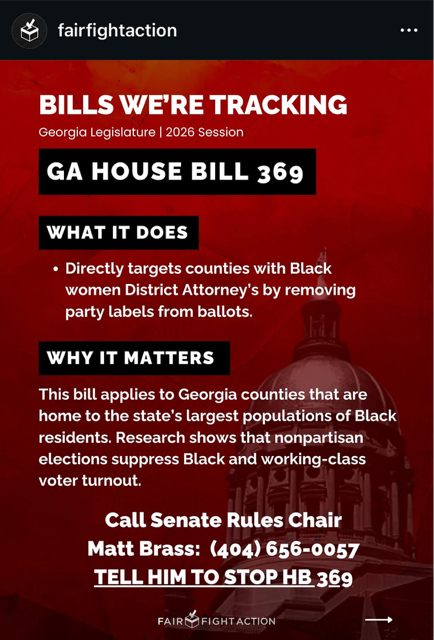
This post on Instagram from fairfightaction is a perfect example of the differences between how voters are discussing the bill in each state. Fairfightaction is a stakeholder that posts about unfair and unnecessary voting legislation in Georgia and the United States. By posting a call to action about Georgia’s HB 369, it proves the differences between the Kentucky and Georgia bills. The reason so many issues have been brought up about HB 369 is that it affects not just the counties but the whole state legislation by making DA elections non-partisan in only five Georgia counties. This makes it much more impactful and selective than Kentucky’s HB 388, which builds on the already common non-partisan local elections happening around the state. Another problem FairFightAction brings up about HB 369 is how it directly targets Black leaders in Georgia by further complicating an already confusing election for voters.
_____________________________________________________________________________________________________
Both Kentucky’s HB 388 and Georgia’s HB 369 highlight the growing debate over nonpartisan elections and their impact on voters. Both change the way the voting ballots for local elections look by removing political parties from the ballot. By comparing the two states, it becomes clear that even though the bills are similar, their effects and the public response can differ. The most important difference between these bills is the impact it has on the state as a whole. Kentucky’s bill was made to include Louisville in on non-partisain local elections, while Georgia’s bill makes the elections between the counties different from each other. Even with their differences, Kentucky’s experience still offers a preview of what could happen in Georgia if the bill is passed. Time will tell if HB 369 will become the beginning of non-partisan local elections across the state, like in Kentucky. This article was made so that if HB 369 becomes law, we can see the possible routes it can take in future local elections. While supporters argue that nonpartisan ballots can reduce political polarization, critics raise valid concerns about unintended issues that could come from it. The best thing Georgia stakeholders can do until they find out if HB369 is being passed is to research how other states have been affected by non-partisan election legislation. If they see the bill as a potential problem, then paying close attention to stakeholders like fairfightaction and voicing their opinion publicly is the best way to enact change.
Leave a Reply