Trey’s Law in Georgia

During this year’s legislative session in Georgia, a bipartisan piece of legislation passed the Georgia General Assembly to protect victims of childhood sexual assault who had their voices silenced by corporate NDAs. HB 1187, or Trey’s Law, bans future NDAs regarding sexual assault cases with minors, as well as dissolve all previous NDAs filed in the state. This bill ensures that all victims, past, present, and future, maintain autonomy of their bodies and their voices to speak out against their violators. Supporters of the bill cite the damage NDAs can have on victims’ mental health, with the law being named “Trey’s Law” to honor the late Trey Carlock, who committed suicide in 2019 after being forced into silence due to an NDA following a SA case in Missouri. In this post, we will review the impact and support the bill has had on different social media platforms.
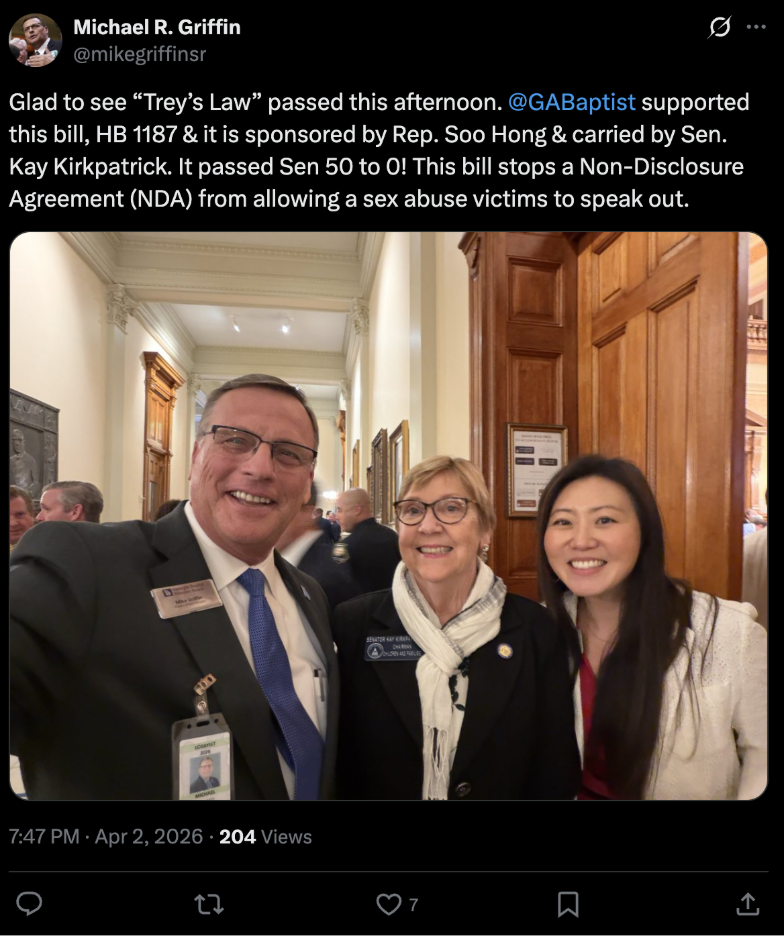
On Twitter, lobbyist and pastor Michael R. Griffin shared his excitement after HB 1187 passed the house 50 to 0. HB 1187, or Trey’s Law, finished its journey through the Georgia General Assembly on April 13th and has officially been sent to Governor Kemp’s office for his signature. The bill, sponsored by Georgia Baptist and other religious organizations, was viewed as a great success for protecting victims in the state by supporters and activists alike. One sponsor told WABE that this bill “frees survivors to share their stories,” instead of allowing predators to pay for silence.
On Twitter, the official Trey’s Law account shares another post about Trey’s Law (HB 1187) passing. The bill was named after Trey Carlock, who, after being abused in a summer camp in Missouri, committed suicide after being prevented by an NDA from speaking out against the abuse. Trey’s sister, Elizabeth Phillips, said, “This room is packed because survivors are finally able to have a venue to be heard in Georgia.”
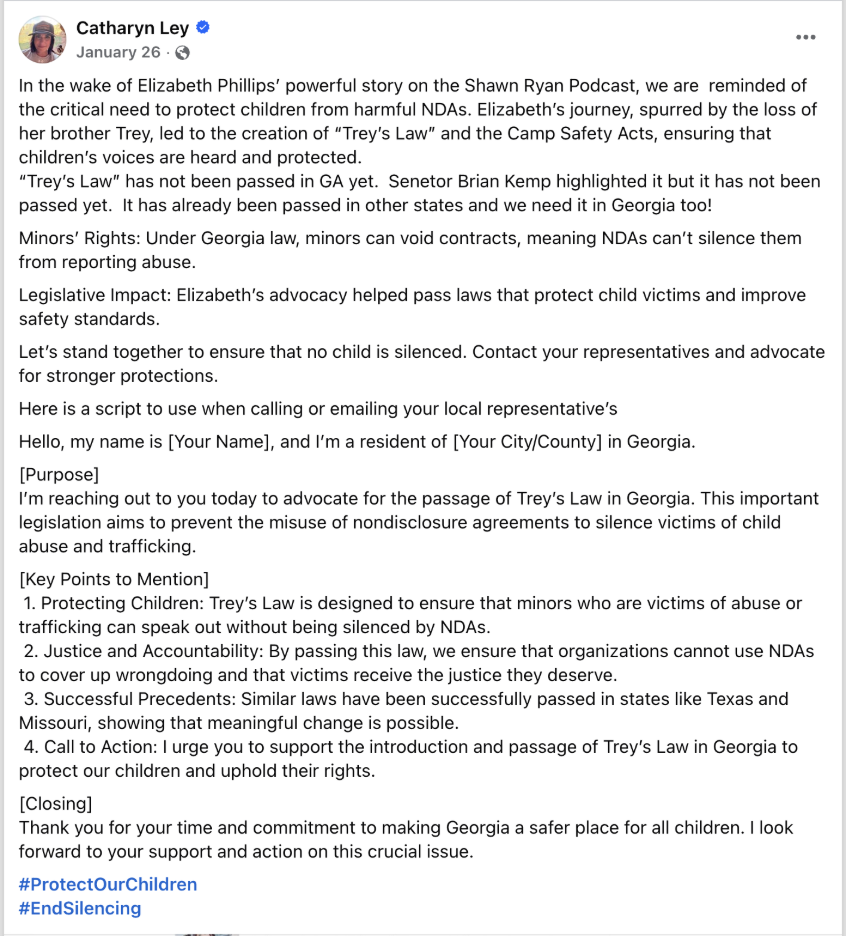
Throughout this year’s legislative session, advocates for the bill, like Catharyn Ley, provided supporters with templates in which to email their representatives demanding that they vote in support of HB 1187 when it came to the floor. Advocates for the bill emphasize the importance of justice for victims who were sexually assaulted at a young age and may not have known what they were agreeing to, as well as protecting future children from hiding their voice. Additionally, experts claim that this bill will help counter the large uptick of SA NDAs that followed the start of the #MeToo movement and prevent further cases.
As Trey’s Law HB 1187 progressed through Georgia’s legislation program, it became very clear that this bill was popular among state representatives and senators. With a unanimous passing of the act from both levels of government, the bill was predestined to end up on the governor’s desk. With First Lady Marty Kemp being the first to bring this legislation to the floor and being an advocate for sexual abuse victims and ending child trafficking in Georgia, Governor Kemp was quick to pass the bill and bring it into law as of April 10th. This came only days before the Crossover and was likely a calculated effort to get the bill through deliberation before the end of this legislative session.
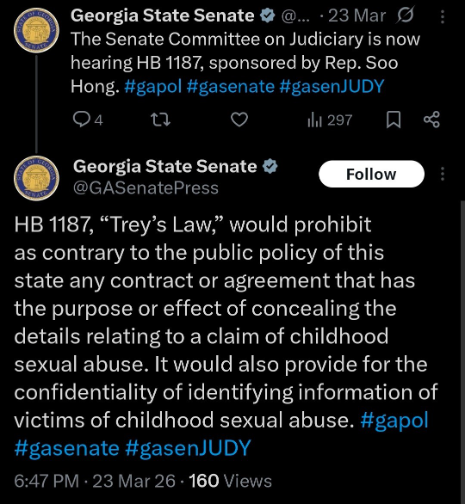
Over on X, the Georgia State Senate Press stated that the committee was actively hearing Trey’s Law. They further replied by stating how despite opposing belief, any contract with the intended purpose to disguise sexual crimes alongside the action of silencing victims is subject to be nullified should Trey’s Law indeed pass. As one stakeholder on Facebook said, parties such as religious institutions that enabled such crimes to be swept under the rug should be outed for doing so. They also emphasized the fact that Georgia Governor Brian Kemp reassured that the bill would receive his signature should it pass.
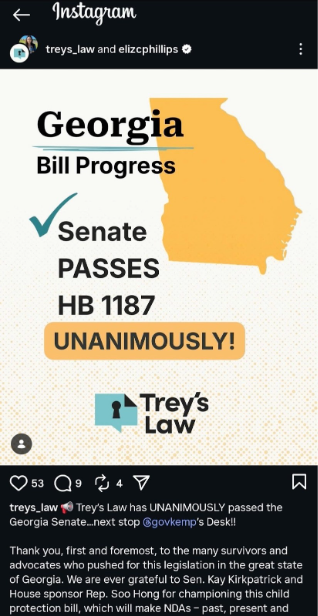
The Official Trey’s Law Instagram account collaborated on a post with Elizabeth Carlock Phillips to announce that the Georgia Senate had passed House Bill 1187 in a unanimous vote. The post credits the numerous survivors affected by NDAs and those who’ve been advocating for years to have them voided. In Columbus, Georgia, the Electric City Life account followed by highlighting the importance of Trey’s Law as it would not only eliminate attempts at new NDAs but also hinder any current ones. Especially for those affected by established NDAs, they may finally be able to speak freely on them without repercussions.
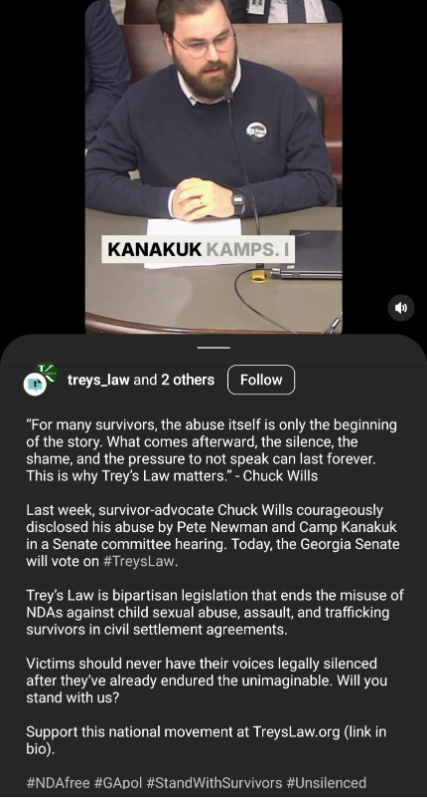
The Trey’s Law Instagram account collaborated with Chuck Wills and Kanakuk Facts to present Chuck Will’s testimony in a committee meeting which depicted the abuse he endured from Pete Newman at Camp Kanakuk. Wills received support from many across Georgia and states all over. @soscaorg called out Kanakuk and how organizations won’t take accountability for the lives they damage. @christian.ariano showed his support by illustrating the importance of people such as Wills speaking up as it ensures children in the future won’t have to go through similar experiences.@eljui restated how all survivors have is their voice and nothing can ever take that away, even NDAs.
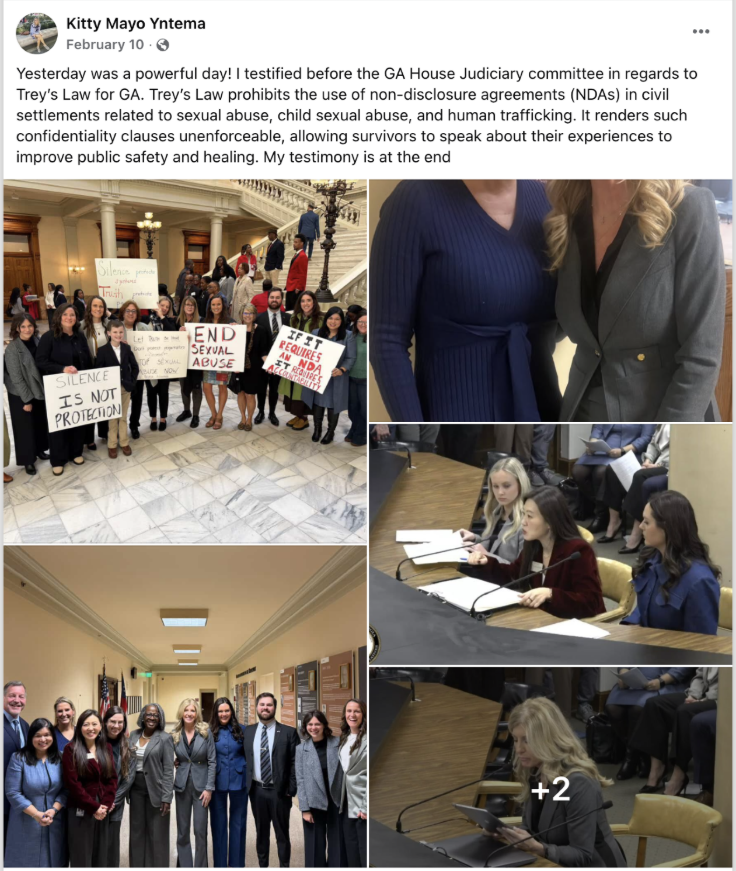
Advocates and representatives for Trey’s law came out in mass to the February 10th hearing before the Georgia House Judiciary Committee. Georgia parents like Kitty Mayo Yntema provided heartfelt testimonies in support of the bill, with some supporters arguing that “these NDA’s force victims to choose between compensation and their voice.” Advocates are pushing to make Georgia the 6th state nationwide to enact some form of Trey’s Law. As of April 10, HB 1187, or “Trey’s Law,“ has passed both the Georgia State House and Senate and is now waiting for Governor Kemp’s signature before it is enacted into state law.
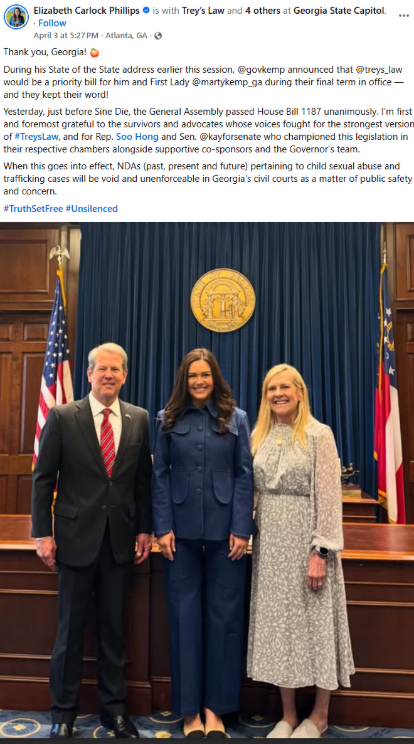
In this Facebook post, Elizabeth Carlock Phillips stands side by side with Governor Kemp and First Lady Marty Kemp after the passing HB 1187 through the Georgia Senate. Phillips is founder of the Trey’s Law nonprofit advocacy organization and has been integral in the success of Trey’s law across the country after the death of her brother in connection to sexual abuse. Besides this achievement, Phillip also serves as the executive director of the Phillip Foundation and sits as the Chair of Board of Governor for the Dallas Foundation, both in Dallas, TX. Both organizations are noted for their “community outreach and investment efforts to influence systematic change.”
Despite the growing polarization of politics in recent years, Trey’s law was able to gain support from all sides of the political landscape. During this year’s legislative session, HB 1187 was successfully pushed to the Governor’s desk with bipartisan support and now awaits Governor Kemp’s signature before it comes into law. While coverage of the bill was minimal, stakeholders took to Facebook, Instagram, and Twitter to voice their support of the bill and to pressure their legislatures to approve the bill when it came to the table. Some supporters even provided templates for constituents to use to message their representatives into protecting children from losing their voice after a sexual assault case.
Something that stood out during this case was the leveling of the political landscape with this bill. Trey’s law passed through Georgia’s Senate with a bipartisan vote of 50 to 0
Leave a Reply