Reflective Portfolio – Katherine Norris

Starting WRIT 3152, I did not know the intricacies and in-depth work we would be doing on bills. Seeing how bills start in the Georgia General Assembly and end up was one of the biggest highlights of this course. Being a GA citizen, learning about bills and collaborating on semester-long projects has changed my perception of group projects. I also was able to learn how to properly use social media as a source within our writings. This was something new to me and our first assigned readings helped shaped my perceptions of online political discourse.
“Democratic self-governance is far harder than it needs to be in online spaces, and autocratic flows of power arise easily— not so much because of the people as because of the tools and the economies that reinforce them. Different tool designs can make self-governance easier to practice and improve. To borrow the canonical phrasing of Langdon Winner, who tangled with determinism too, these artifacts have politics” (Schneider, 10).
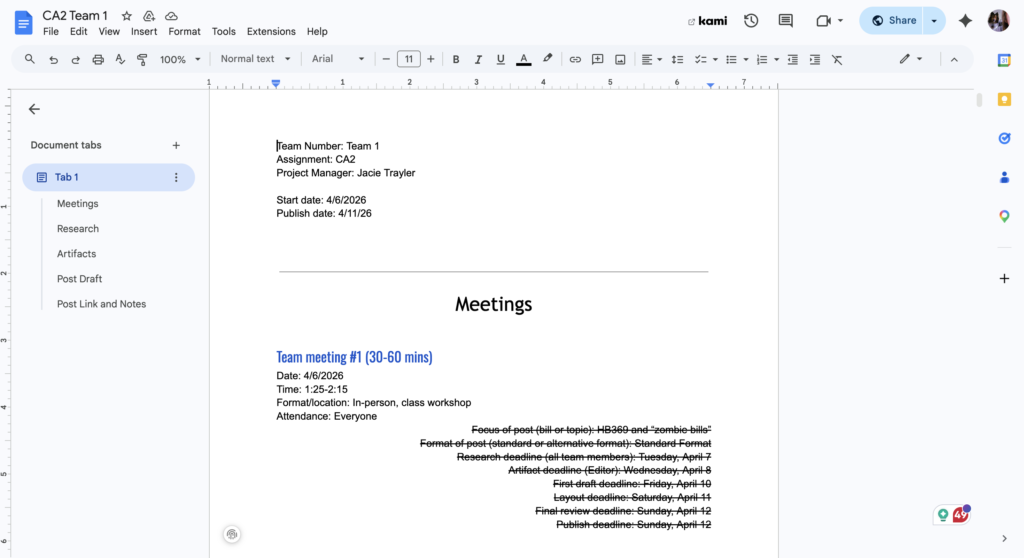
When the semester started, we were able to join groups and declare which positions or roles we wanted to do. I was paired with Jacie, my project manager (PM), and knew I wanted to stay with him as the groups went on. Luckily, he felt the same, and we were able to choose our declared group with Calvin (designer) and Alex (editor). Collaborating with these three individuals taught me how to manage other roles I would not have chosen otherwise. I was the researcher, something I am very familiar with, but by watching Jacie, Calvin, and Alex, I was able to learn more collaborative skills through their roles.
- Jacie was able to organize documents in the artifact listed above, where we were able to seamlessly input sources, divvy out annotations, and declare our group meetings.
- Calvin jumped into WordPress without prior knowledge of the platform and designed all the posts we created.
- Alex was able to break down the direction we should take our post and ultimately allowed us to visualize how we wanted to deliver information.
- I learned how to input the majority of the sources we used, chose a good amount, and delivered organized research during meetings.
Our roles and organized behaviors were the catalyst for our ease of communication between all four of us. Typically, when I am in group projects, I am nervous about the collaborative aspects, where I end up doing major grunt work while others may sit back. However, this was not the case with my group. In this reflective portfolio, you will be able to see what we created together, something we are all most proud of from this semester, and other topics I learned more about.
The first collaborative assignment (CA1) we did, we learned the dynamics between the four of us and our strong suits. Carrying this forward, we knew we wanted to stick with our groups and original roles as we went into CA2 and CA3. Out of these three assignments, our CA2 post is the collaborative product I am the most proud of this semester. We chose to cover HB 369, a zombie bill that was originally about food trucks, which was turned into a nonpartisan election bill, targeted at five metro counties in Atlanta. During this process, we had to communicate with another group that also wanted to cover HB369. Jacie was able to claim our group’s ability to go forward with HB 369 in CA3, where we were able to compare the bill to another state’s similar legislation. Doing both of these collaborative assignments with a group I trusted was exciting work. All four of us felt ecstatic that we found a zombie bill that was so prevalent, one that is currently not signed by Kemp, and we were able to research more about it. This bill was first introduced in 2025, was rewritten and resurfaced in 2026 as “any legislation filed last year is still in play for the 2026 session” according to the rules of the Capitol (Baruchman & Prabhu, 2026). Since this bill was introduced first as a food truck bill, and was withdrawn and recommited by the Senate, it fits into a revival bill.
To first carry out our research on CA1-CA3, we utilized many different proprietary platforms via X, Facebook, Instagram, and TikTok. This was the first time that I had worked with social media sources as primary sources for academic work. By doing this, I learned how to differentiate between stakeholders, journalists, and politicians. We were tasked with finding only Georgia citizens for the three categories, and the post had to do with the current work within the General Assembly. An example of a stakeholder is Holly Kesler, a very active citizen of Georgia who is not an elected official and is not affiliated with a journal. We cited her tweets from X in two of our CA posts, as she is a very effective stakeholder- as seen above. Typically a good stakeholder is one gaining attention or drawing attention to an important legislative topic.
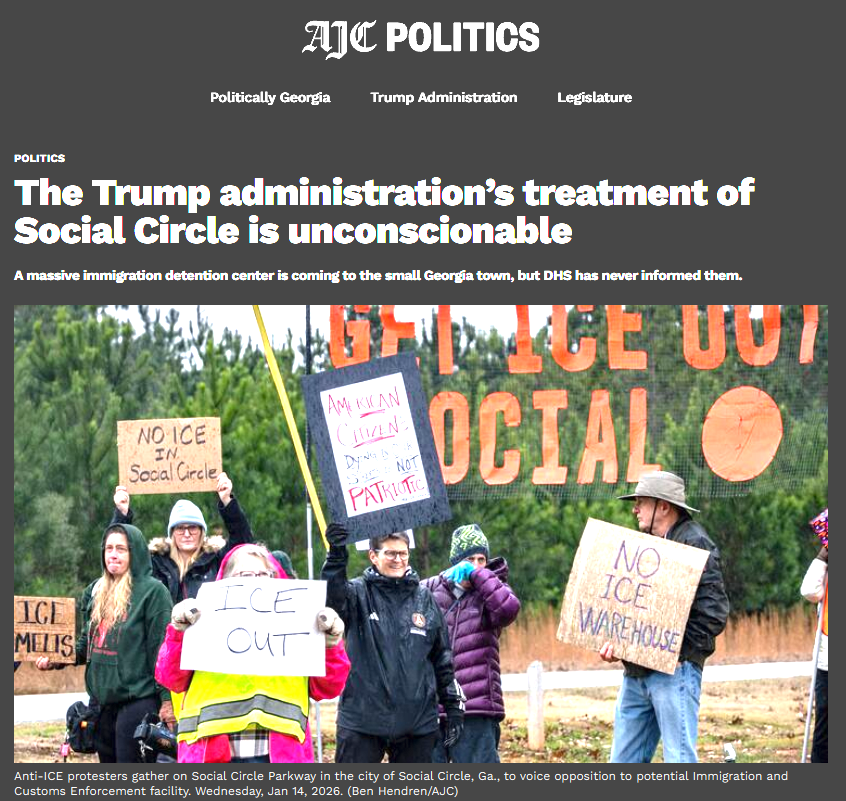
For our journalists, these can come from the AJC or any other affiliated journal company. We primarily found these online through open source platforms, which are different than proprietary platforms because they are owned or controlled by individuals, where open sources can be shared and modified. A source we used for CA1, “The Trump administration’s treatment of Social Circle is unconscionable,” shows an example of an active journal site we were able to cite. We knew that the AJC was an easy choice of a journal to use, granted we all have a subscribed access to it, we also put our attentions toward other news outlets like FOX5, CNN, and CBS News for our collaborative assignments.
“Once black communities are winning and being equally represented, some try to change the rules instead of respecting the results.” – Mo Ivory’s TikTok
To break up between stakeholders and journalists seemed pretty straightforward, because if an individual is with a journal and currently works there, they fell straight into the journalist category. If an individual had no affiliation with either a journal outlet or currently represents GA in a poltiical sphere, they are automatically a stakeholder. However, finding politicians who are active, currently elected, or appointed, was a bit trickier. We had to ask Pete several times if a person was considered a politician and gain clarity because it does depend on their positions or affiliations. We found several examples of politicians from X, Instagram, and TikTok, all of which we used through CA1-CA3. Above is an example of a politician we used, Mo Ivory, and how we cited her in our CA2 post.
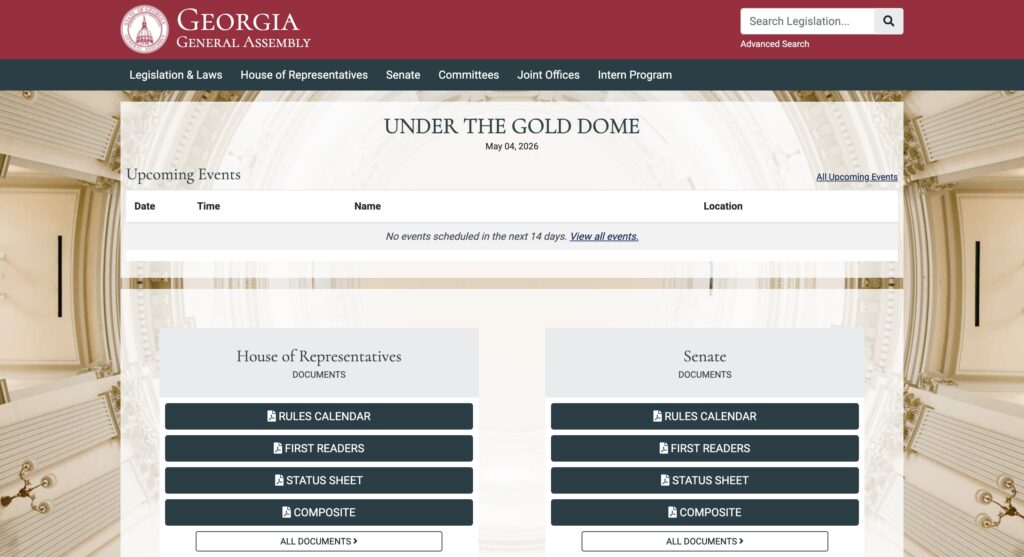
Besides learning something new about social media and how to use it as a source, I learned how to engage in state politics and civic engagement. A major part of the sources we utilized were from the GA General Assembly website, where we would find bills or state representatives who sponsor bills. In my Experiential Activity post, I talk about my experience at the Capitol, where I was able to witness different speakers, like House Speaker Jon Burns (R-District 159), and engage in conversation with State Representative Kim Schofield (D-District 63). By learning how to read the website and gain prior knowledge of bills, when I attended the Capitol, I was able to take down notes that I then could go look up after leaving. I learned that zombie bills are a thing, which I did not know previously, and that politicians use social media to their benefit to spread awareness, support, or disapproval of bills. For civic engagement, HB 369 showed major signs of protest and a call to action for vetoing the bill. We found several organizations, like the Georgia Black Caucus Organization and the Because We Care Organization. Both of these organizations showed actions to address public concerns with HB 369 and direct civic engagements. This method of civic engagement seems the most effective and accessible for multitudes of people. I do not personally approach civic engagement via social media or in conversations this way; however, it was very beneficial to learn. I am now able to take this information into account as I get into more political spheres in law school.
As I have mentioned, I was the researcher for my group through all of the assignments we completed together. I do have background knowledge on how to research, as far as databases and what is deemed “scholarly” in academia. However, this was my first time researching for social media sources or posts, and how to utilize them in an academic realm. I really enjoyed getting to know different platform’s way of finding these sources, and I was very unfamiliar with X’s platform since I have not used it in several years. Something new I learned is that you can click directly on the date of a tweet, copy the link, and it will always take you to that direct tweet as well as update it if the account updates it. For our assignments, this was extremely helpful when we would directly quote from social media posts and we were able to directly embed the tweet, post, or account we wanted to source.
Funnily enough, I did not know that this class was offered to me, despite wanting to go to law school. I had a meeting with Pete where we discussed my options for an internship and he offered me to take WRIT 3152 in the spring. I believe that this class not only has supported my learning interests and goals, but has directly emphasized my appeal to law. I feel very fortunate that I had the ability to travel to the Capitol, get to know current lawmakers and see passing bills to the Senate in action. Not only were deciphering bills a challenging goal for me, but learning better ways to collaborate with peers will be something I take into my further careers. I first was nervous to do group projects, but I asserted myself into the first opportunities and did not hold back. I was able to see designs differently via WordPress, and can say I feel suffiecient in the platform. Since I did an internship and Pete was my coordinator, I used WordPress to gather my relfective journal throughout the semester. Doing so, I have more knowledge on the site creation and can use it to show anyone what I did during my Spring internship. I recommend anyone to take this course if they are interested in gathering artifacts and creating an online space to show any possible job employer. Pete has been able to give me vast amounts of opportunties and experiences- as we are now heading into a Capstone course in the Fall, conducting more research. I even recommended the class to one of my peers in a different class. Overall, I would take this class again if I could and I will miss it come fall.
Leave a Reply