CA3 Post Team 2- Voter Ballots: GA & CO

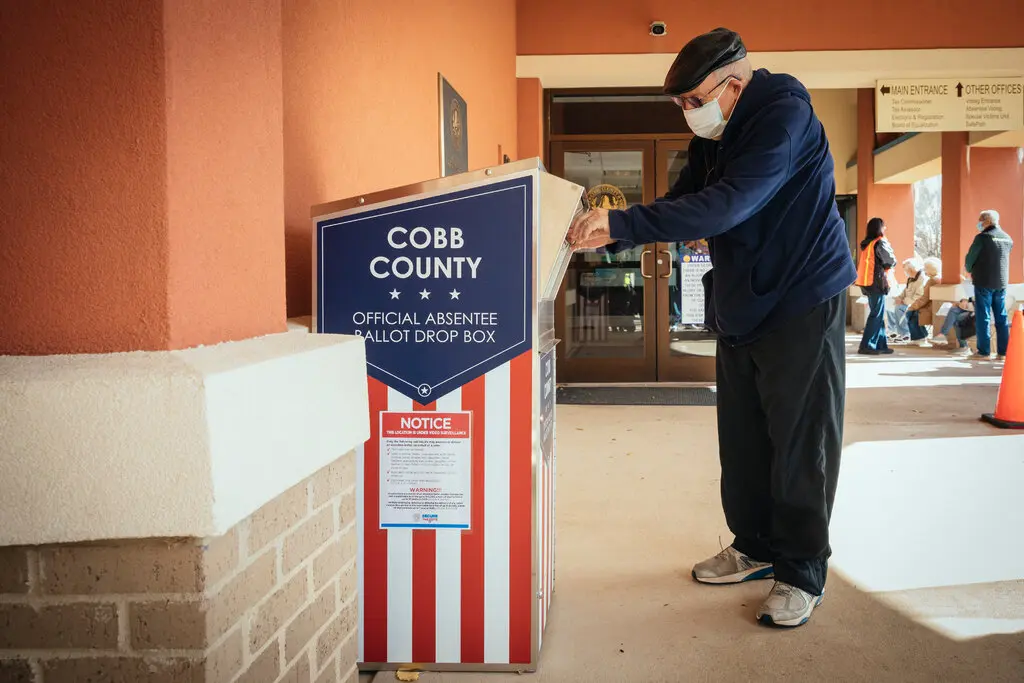
Photo provided by: Audra Melton
Team 2:
Ken C, Jay E, Paige M, Emma H
The debate over election security and voting technology, especially regarding the use of QR codes, has increased over the past couple of elections. Recent legislation in Georgia such as Senate Bill 189 and HB 960 has created uncertainty by banning QR codes without a replacement system in plan. In contrast, Colorado made their decision on QR codes back in 2019. Jena Griswold, the Colorado Secretary of State, announced this before the 2020 and 2024 presidential elections. Throughout these artifacts, we look at policy differences between Georgia and Colorado. Delving into social media commentary, reporting, and policy decisions, we look at the role of media in politics.
Recently, President Trump has been pushing to ban these QR barcodes on ballots. These QR codes are used to count ballots and are seen to speed up the voting process. The reasoning behind Trump pushing to ban these is because of security issues and the current focus on trying to move towards paper voting. The idea behind banning QR codes on ballots is that it would build up security and account for more accurate voting counts as they would be by hand.
As Colorado became the first state to ban QR codes, before President Trump approached the idea, we will look at how their voting system varies from the Georgia voting system. Collected are social media and journalistic posts covering this discourse to develop a better understanding in comparing and contrasting Colorado to Georgia. We will look at how stakeholders view this issue and how their views compare. These artifacts will show how election policy is shaped by law and perception analyzing trust and transparency in current modern voting systems.
Georgia:
This tweet by Greg Bluestein, who works for the AJC, talks about the current issues with election laws in Georgia. Due to Senate Bill 189 signed back in 2024, QR codes are banned for voting. The issue here is that Georgia’s current voting system used these QR codes to count votes. At this point, there is no law in place that explains how this will be replaced. The 2024 QR code ban will be in effect starting July 1st of this year, 2026. This is vastly different from Colorado’s voting laws. Back in 2019, the Colorado Secretary of State, Jena Griswold, announced that Colorado will be banning voting ballot QR codes. With there being a 7 year difference, Colorado was way ahead of their time.
Georgia’s 2024 Statewide Risk Limiting Audit Confirms Voting System Accuracy
This article from the Georgia Secretary of State highlights small inconsistencies in the 2024 election in Georgia regarding audit and machine count. With only a 8 voter count difference between the audit and machine count, this article argues that Georgia’s current voting system is up to par. After hearing about the results, Brad Raffensperger, the Secretary of State, said that Georgia’s voting system is one of the top in the country. Comparatively, back in September of 2025, President Trump said that he has a major problem with Colorado’s voting system. He claimed that Colorado’s mail in voting is considered “dishonest”.
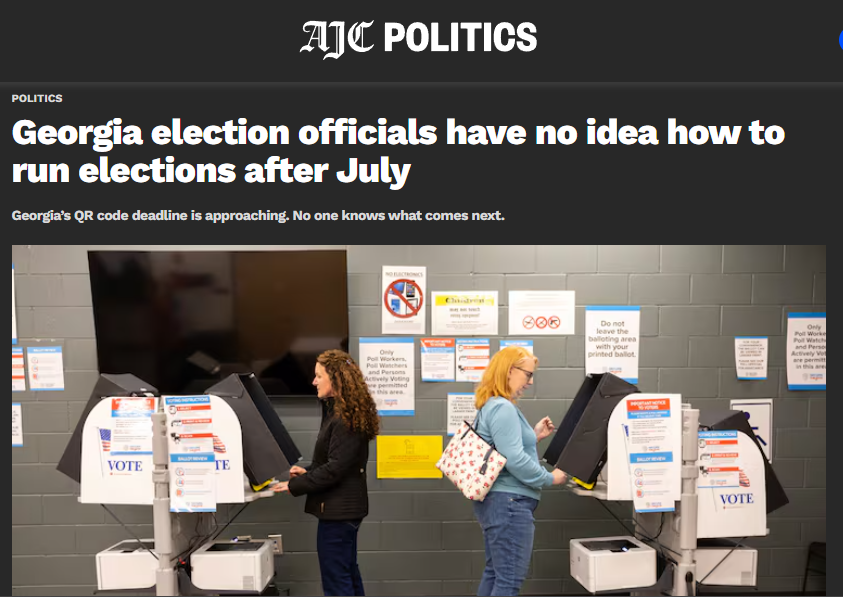
The AJC article written by Caleb Groves details the current voting climate within Georgia after the FBI seized ballots from the 2020 election in Fulton County back in February. The voting uncertainty within the state that still presides mentions the use of electronic votes alongside its QR code counterpart as being unfair and manipulated by poll workers. This backlash has opened up conversations about whether Brian Kemp will call the GOP back into session this summer to figure out how ballots will be counted for midterm elections that will affect major seat and party changes for the state in November. The passing of HB 960 in late March of this year has also pushed for a clear answer as to what Georgia ballots will look like and how they will be counted by the first of July. The main solution, which includes machine counting of paper ballots with a specific computer system, still raises eyebrows due to its quick turnaround and further concerns about the variety of ballots needed for each Georgian’s needs.
Georgia X user (@LaurenDownSouth) comments on the AJC article mentioned above, noting that the argument made by the GOP to promote paper ballots when voting for the midterms, as Lauren argues that the back and forth change of belief from the Georgia Government has led to a mistrust of voting practices in the state. Many counties within the state, along with Fulton county, have had voting issues due to its large size and conspiracies between poll workers. Republican Georgians view this change as being a way to protect their votes, while Democrats argue it is another reason for voters to feel more unwilling to go out and present their community in voting. Paper ballots with a QR code have been the norm in Georgia and without it there are concerns about true representation.
In a post by Garland Favorito (VoterGA), an overview of current election controversies is given. In this post, Favorito explores one of the attempts at legislating voting methods in Georgia. SB214 was a bill proposed to extend the deadline for changing the QR code voting system from July 1st, 2026, to February 2027. One of the main issues with QR ballots is the lack of voter verifiability. This was addressed in previous legislation, which gave 2 years for the Georgia General Assembly to come to an answer. 2 years later, and with no better answers for what voting methods would rectify the situation, intervention has come from a federal level. This has put Georgia into murky waters, as legislators now are faced with a choice to either make a quick transition into a system that may not work well for a major election, or proceed with a potentially unreliable and illegal system until they can come to an agreement. As the deadline crawls closer for a decision to be made, legislation continues to shift, with no answer quite sticking.
Colorado:
Colorado Secretary of State Takes Action to Increase Cyber Security, Announces Initiative to Remove QR Codes from Ballots
In a press release from 2019, Former Colorado Secretary of State Jena Griswold announced the removal of QR codes from the voting system. Up until 2019, when Coloradans voted at a polling location, the BMD would mark their ballot with both the name of their candidate and the associated QR code, however, there was no provided method to verify the accuracy of the QR code once printed on the ballot before tabulation. To eliminate this uncertainty, Colorado began requiring tabulation “using only human-verifiable information and not QR codes.” Griswold cites the attempted intervention of Russia in the 2016 United States Presidential election as reason for removing QR code voting, stating: “We live in a constantly changing threat environment. Hostile actors will continue their efforts to discover vulnerabilities in the attempt to undermine confidence in our elections. We must continually assess all election systems to identify areas that should be improved. Our adversaries are not standing still, and neither can we.” The U.S. intelligence community has confirmed these claims, suggesting that the likelihood of future attempts at intervention are high. This is supported by the fact that the U.S. has not been the only target of infrastructural destabilization by the Russian Government. While there is no evidence that Colorado’s voting system in particular was affected by such attempts, this change in legislation is a preventative measure to protect against potential attacks.
Colorado’s Secretary of State, Jena Griswold made a post back in 2019 about Colorado’s initial ban on barcodes on voter ballots. Griswold’s reasoning for the barcode ban is to improve election security, specifically surrounding the state’s ballot counting system. She also argues that the state’s voting system should not rely on a computer to read and submit a voter’s ballot. Additionally, she links a news article that features her input on this change, which reports Colorado becoming the first state to set this ban into place. It is important to note the article includes information that claims security experts insist that a computer using a barcode to read a ballot is not significant when votes have to be audited afterwards either way. However, the article also brings up concerns from the 2016 election, and claims the changes being made are to prevent future elections from being interfered with.
Colorado X user, Charles Ashby, who is a local reporter for Colorado newspaper, The Daily Sentinel Grand Junction, posts a quote tweet in response to a tweet made by Colorado’s Secretary of State, Jena Griswold. Ashby talks about the news article that Griswold linked in her original post, where he argues that the article is missing critical information in regards to voter turnout and voting method statistics. He then claims that ballots that were using QR codes leading up to the barcode ban, made up less than 3 percent of everyone in the state that voted. This argument would mean that a large majority of the state votes through mail-in or absentee ballots, which already cannot use QR codes in the first place.
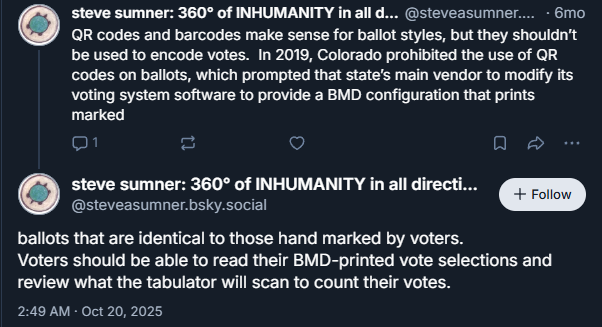
Bluesky user Steve Sumner posts a recent thread where one of the posts references Colorado’s decision to ban QR codes on ballots back in 2019. Sumner uses this reference to support his argument that encoded barcodes should not be on voter ballots. He goes on to explain how after Colorado set the ban into place, their voting system software had to then be modified to better accommodate voters when marking their choices on said ballots. The modifications made now electronically mark ballots in a way that resembles a hand-marked ballot when it is casted. Sumner goes on to elaborate how these software modifications help voters be able to more accurately read their ballot. This method shows a strong argument in favor of the benefits of paper-marked ballots without the rising concerns of barcodes that have been present in Georgia recently.
In a twitter post by Break the Chains Media, the Colorado paper ballot system is criticized. A video embedded in the post shows chaos on the floor of a GOP election in Colorado, as 80 extra unverified ballots were counted in the election. Debates sprung up as to what the next move should be, as to redo the vote would mean some who voted before would not be able to again, whereas if the extra votes were to be discounted, that’s 80 people whose ballots were not recognized. Despite pushes in the United States Government at both federal and state levels for paper ballots, this example of election by paper ballot gone awry is a good example of why paper ballots are not an end all be all solution to vote accuracy. Ultimately, the answer to accurate voting is, generally, good management.
From 2019 to 2026, both Colorado and Georgia have experienced vastly different arguments and even agreements from both democrats and republicans on the issue of QR codes on ballots. As Colorado found itself in 2019 arguing for the removal of bar codes as safety concerns were mounting within the state’s election cycles because of the international worry of Russian interference. In the years following this landmark decision, as Colorado was the only state to implement such chances to ballots, there has been some arguments about the problematic nature of the banning of QR codes such modification concerns and doubt over it’s protection of Coloradans.
The uncertainty that Georgians have to face now has created a deeper conversation of how paper ballots, along with new systems that count said ballots, will operate. Both sides of the aisle in Georgia now have to potentially compromise if Governor Kemp decides to call the legislation back into session before midterms roll around. Prominent bills like SB 189 and HB 960 within the GOP have created confusion and an unclear direction of where Georgia politics see voting fitting within both parties and their wants. Mistrust now lies predominantly in the Democrat sphere and without a clear direction many voters are wondering what will happen to their county as it is time to face their ballots, paper or screen.