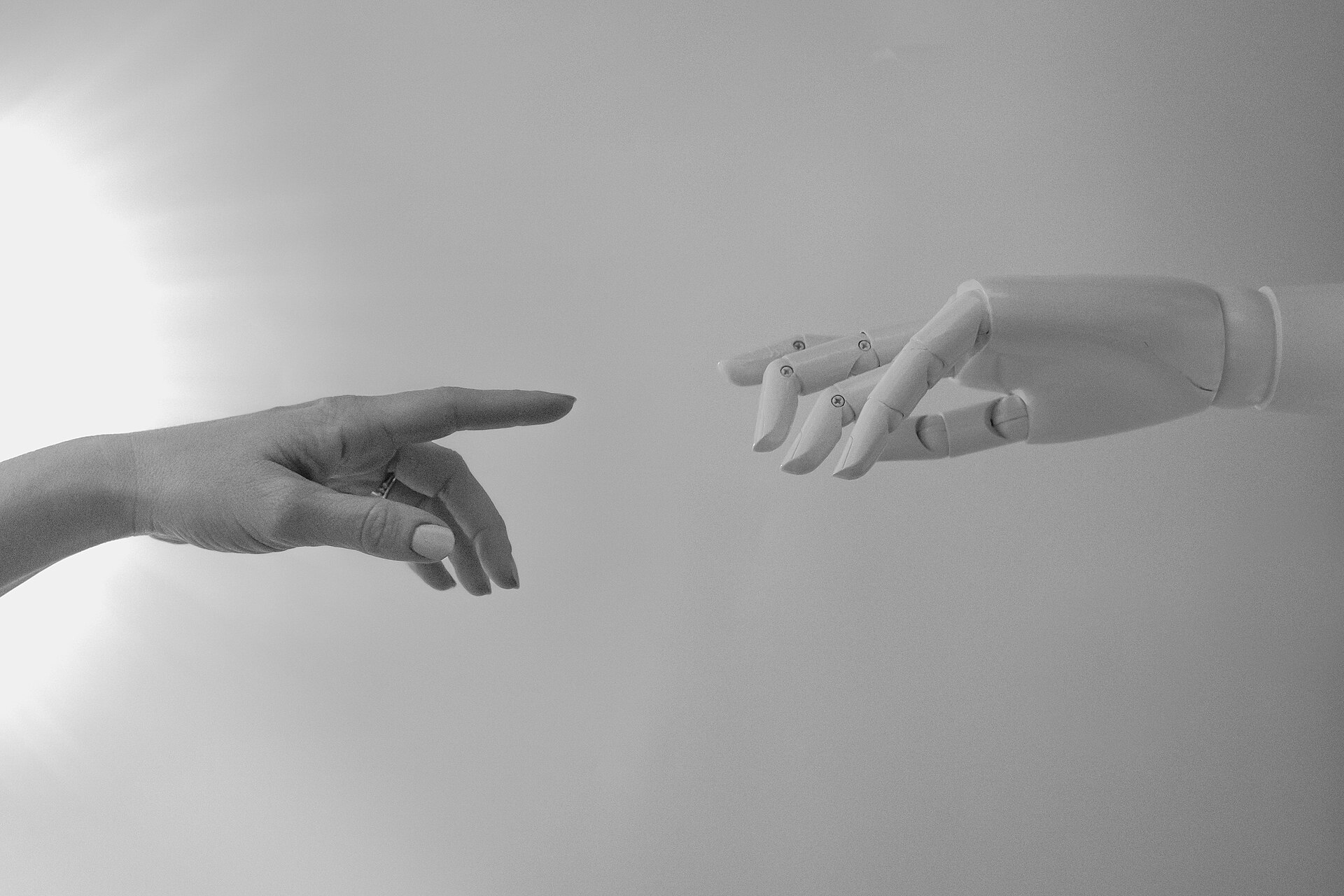
Image courtesy of JSkourr via Wikimedia and Creative Commons

Written by: Camden A, Abbie R
Edited by: Walaa K, Katherine N
Technology has always changed the way humans communicate, but it has also changed the way people understand truth, memory, and themselves. As artificial intelligence, digital media, and instant communication continue to reshape everyday life, questions about what it means to be human have become more relevant than ever. Both Arrival, directed by Denis Villeneuve, and Ted Chiang’s short story “The Truth of Fact, the Truth of Feeling” explore these questions through different forms of language and technology. One tells the story of humanity’s first contact with an alien civilization, while the other follows two narratives separated by centuries; both works argue that communication is far more than the simple exchange of information. Instead, they suggest that new ways of communicating reshape how people experience reality, remember the past, view the future, and define themselves.
One of the strongest similarities between the two works is their belief that communication should come before conflict. In Arrival, linguist Louise Banks is chosen to communicate with the heptapods because she understands that language must be built from simple concepts before complex questions can be answered. While military leaders demand immediate explanations, Louise patiently establishes trust by teaching names, introducing the word “human,” and slowly building a shared language. Louise’s consideration saves the world when a mistranslation of the phrase “offer weapon” nearly caused several countries to declare war. Rather than presenting language as a simple tool for exchanging information, the film argues that misunderstanding language can be just as dangerous as any weapon. Likewise, in “The Truth of Fact, the Truth of Feeling,” Jijingi struggles to understand why his people’s oral storytelling traditions allow for multiple versions of the same story. The missionary who teaches him to read and write views truth as something fixed and factual, while Jijingi gradually learns that stories can preserve emotional and cultural truths even when the wording changes. In both works, understanding another perspective becomes the first step toward preserving humanity in moments of uncertainty.
Chiang and Villeneuve demonstrate that language has the power to change the way humans perceive reality itself. As Louise immerses herself in the heptapods’ circular written language, she begins experiencing time differently, seeing the future alongside the present. What initially appears to be memories of her daughter is eventually revealed to be visions of future events. Villeneuve’s nonlinear storytelling allows the audience to experience this revelation alongside Louise, reinforcing the idea that language can fundamentally reshape perception. Similarly, Chiang’s future storyline introduces Remem, a technology that perfectly catalogs every recorded moment of a person’s life. Journalist Harris believes this technology threatens humanity because natural memory softens painful experiences and reshapes the past in meaningful ways. However, when Remem reveals that he, rather than his daughter, was responsible for a painful argument they both remembered differently, he realizes that the technology did not create the problem. Instead, it exposed the flaws already present in human memory. Chiang and Villeneuve suggest that communication and technology do not simply provide information; they transform how people understand truth itself.
Although both texts examine technological progress, they ultimately remain focused on humanity. In Arrival, Louise discovers that she will one day have a daughter who will die from an incurable illness, yet she still chooses to embrace that future. Her knowledge does not eliminate grief, but it allows her to appreciate every moment she will share with her child. By choosing to embrace a future she knows will end in loss, Louise demonstrates that the value of human connection lies not in avoiding suffering but in accepting it as part of love itself. The film argues that understanding does not protect people from pain, but it can give suffering greater meaning. Chiang’s story reaches a similar conclusion through its historical narrative. As Jijingi becomes increasingly devoted to written language, he begins criticizing his elders for failing to tell stories exactly the same way each time. Eventually, he realizes that focusing solely on factual accuracy causes him to overlook the emotion, culture, and humanity carried within oral storytelling. Written language preserves facts, while spoken stories preserve feeling. Together, both narratives remind readers that communication is valuable not because it creates perfect accuracy, but because it allows people to connect in meaningful ways.
Perhaps the most compelling idea shared by both works is that humanity is not diminished by new technologies but continually redefined through them. The heptapods’ language expands Louise’s understanding of time without diminishing her compassion, while Remem forces Harris to confront uncomfortable truths about himself instead of allowing him to hide behind imperfect memories. Likewise, Jijingi’s experiences with literacy reveal that factual truth and emotional truth can coexist rather than compete. Neither work argues that progress is inherently good or bad. Instead, both suggest that every advancement in communication changes the way humans understand themselves and those around them, forcing them to balance objective knowledge with empathy, memory, and personal experience. Whether through alien symbols, written language, or artificial intelligence, communication becomes a mirror reflecting both humanity’s greatest strengths and its deepest flaws. Ultimately, both works suggest that the greatest purpose of communication is not simply to exchange information but to cultivate empathy between people whose experiences differ.
Arrival and “The Truth of Fact, the Truth of Feeling” offer an optimistic view of humanity’s future despite their warnings about misunderstanding and technological change. Both works acknowledge that innovation can challenge long-held beliefs about truth and identity, yet they argue that these challenges also create growth opportunities. In an age increasingly shaped by artificial intelligence and rapidly evolving technology, their messages feel especially timely. Facts alone cannot define what it means to be human, nor can perfect memory or flawless communication. Together, these works suggest that humanity’s greatest strength lies not in possessing perfect knowledge but in remaining open to understanding others despite uncertainty.
Leave a Reply